
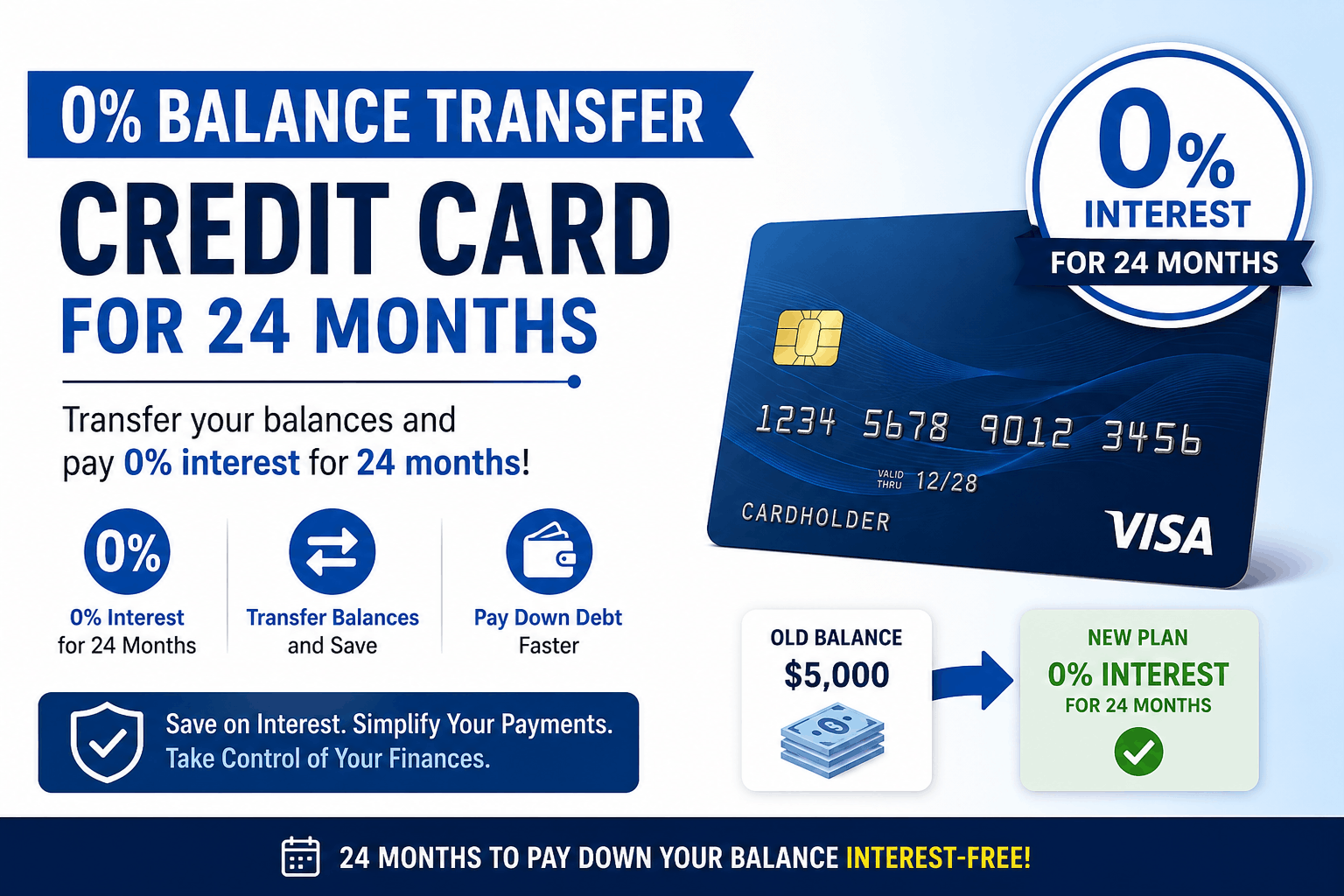
Carrying credit card debt at 20%+ APR is exhausting. You make payments every month, the balance barely moves, and it starts to feel like the interest is working harder than you are. That’s exactly why 0% balance transfer offers exist — and a 24-month window is one of the longest you’ll find anywhere right now.
But these offers come with conditions most people don’t read carefully enough. This guide breaks down how they work, which cards are worth considering, what the hidden costs look like, and how to decide if this move actually makes sense for your situation.
Table of Contents
Quick Answer: Is a 24-Month 0% Balance Transfer Worth It?
For most people carrying $3,000 or more in high-interest credit card debt, yes — a 24-month 0% balance transfer card can save hundreds or even thousands of dollars in interest. But you have to pay off the balance before the promotional period ends, avoid new purchases on that card, and account for the upfront transfer fee.
At a Glance: Key Details
| Feature | What to Expect |
|---|---|
| Intro APR | 0% for up to 24 months |
| Balance Transfer Fee | Typically 3%–5% of transferred amount |
| Regular APR After Promo | 18%–29% depending on creditworthiness |
| Minimum Credit Score Needed | Usually 670+ (good credit) |
| Best For | Paying off existing high-interest debt |
| Biggest Risk | Reverting to high APR if not paid off in time |
What Is a 0% Balance Transfer Credit Card?
A balance transfer card lets you move debt from one or more existing credit cards onto a new card that charges 0% interest for a set promotional period. The 24-month version gives you two full years to pay down that balance without interest piling on top.
The math is straightforward. If you owe $5,000 at 24% APR on your current card, you’re paying roughly $1,200 in interest per year just to stand still. Move that balance to a 0% card, pay a one-time 3% transfer fee ($150), and suddenly every dollar of your payment actually reduces your balance.
That said, the card issuer isn’t offering this out of generosity. They’re betting some percentage of cardholders won’t pay it off in time — or will use the card for new purchases at the regular rate. Knowing that dynamic going in changes how you use the card.
Best 0% Balance Transfer Cards With Long Promotional Periods
The landscape changes regularly, so always verify current terms directly with the issuer. That said, here are the card categories that consistently offer the longest 0% windows.
Cards With 21–24 Month Intro Periods
Citi® Diamond Preferred® Card
- Best for: People who need maximum time to pay off a large balance
- Intro offer: Up to 21 months at 0% on balance transfers (verify current offer)
- Transfer fee: 5% (minimum $5)
- Regular APR: Variable, based on creditworthiness
- Downside: Higher transfer fee than some competitors
- Who should avoid it: Anyone planning to make purchases — the purchase APR kicks in immediately after the intro period
Wells Fargo Reflect® Card
- Best for: Borrowers who want flexibility and a long runway
- Intro offer: 0% for up to 21 months (can extend with on-time payments)
- Transfer fee: 5% for the first 120 days, then 5% ongoing
- Downside: You must transfer within the first 120 days to get the promotional rate
- Useful detail: Cell phone protection benefit included
BankAmericard® Credit Card
- Best for: Straightforward, no-frills debt payoff
- Intro offer: 0% for 18 billing cycles on balance transfers
- Transfer fee: 3%
- Regular APR: Variable
- Why it stands out: Lower transfer fee compared to 5% competitors
Comparison Table: Long-Term Balance Transfer Cards
| Card | Intro Period | Transfer Fee | Regular APR | Best Feature |
|---|---|---|---|---|
| Citi Diamond Preferred | Up to 21 months | 5% | Variable | Long window |
| Wells Fargo Reflect | Up to 21 months | 5% | Variable | Extendable period |
| BankAmericard | 18 billing cycles | 3% | Variable | Lower fee |
| U.S. Bank Visa Platinum | Up to 21 months | 3% | Variable | Low fee + long period |
Always confirm current offers directly with the card issuer before applying — promotional terms change.
Real-World Cost Example
Here’s what the numbers look like in practice.
Scenario: You have $6,000 in credit card debt at 22% APR.
Without a balance transfer:
- Monthly interest charge: ~$110
- Over 24 months (minimum payments): You’d pay $1,500–$2,000+ in interest
- Balance barely moves if paying minimums
With a 0% balance transfer (3% fee):
- Transfer fee: $180 (one-time)
- Monthly payment needed to clear balance in 24 months: $250
- Total interest paid: $0
- Total cost of the transfer: $180
The savings in this scenario: potentially $1,500+ minus the $180 fee. That’s real money.
The math looks clean on paper. Whether it works in real life depends entirely on whether you actually pay it off in time and don’t add new debt.
Hidden Fees and Traps to Watch
This is where people get hurt. The offer sounds perfect, but a few things can unravel the whole plan.
The Transfer Fee Adds Up Fast
A 5% fee on $8,000 is $400. That’s not small. You’re still saving money compared to paying 22% interest for two years, but it raises the break-even point. Run the numbers before you transfer.
The Intro Period Has a Clock
The 0% window starts from account opening — not from when you complete the transfer. Some cards give you 60–120 days to initiate a transfer. If you wait three months to move the balance, you’ve already burned through part of your promotional window.
Deferred vs. Waived Interest
This is critical. Some promotional offers use deferred interest — meaning if you don’t pay the full balance by the end of the promo period, all the interest that would have accumulated gets charged retroactively. This is more common with store credit cards than bank transfer cards, but always read the fine print. True 0% promotional APR means interest doesn’t accrue — it’s not hiding in the background waiting to appear.
New Purchases Usually Aren’t Covered
Most balance transfer cards apply the 0% rate only to transferred balances. New purchases often carry the regular APR immediately. Some cards don’t apply your payments to the higher-APR balance first. The CFPB has rules about payment allocation, but it’s worth understanding how your specific card handles this before swiping.
Missing One Payment Can End the Promo Rate
Many issuers have terms that allow them to cancel your promotional APR if you miss a payment. One late payment, and suddenly that 0% rate becomes 25%. Set up autopay for at least the minimum as soon as the card arrives.
Common Mistakes People Make
Transferring more than they can realistically pay off. If you transfer $9,000 but can only afford $300/month, you won’t clear it in 24 months. Calculate how much you can actually pay monthly, then transfer only what fits.
Using the card for everyday spending. It feels convenient. The card is in your wallet. But every new purchase adds to a balance that will eventually face the regular APR — and your payments might not be reducing that portion first.
Applying right before a major purchase. A new credit card application temporarily lowers your credit score. If you’re planning to apply for a mortgage, car loan, or any other financing in the next 6 months, the timing matters.
Keeping the old card open and spending on it. This is how people double their debt. Close the old card or freeze it — literally put it in a drawer. Some people keep it open for credit utilization purposes, which is valid, but that requires discipline.
Not reading the transfer deadline. If your card requires transfers within 60 days of opening and you miss that window, you don’t get the promotional rate.
Who Should Avoid a Balance Transfer Card?
Balance transfer cards aren’t the right tool for every situation.
If your credit score is below 670, approval is uncertain and the card might come with a shorter promo period or higher regular APR. Check your score with Experian or Equifax before applying.
If you can’t afford the minimum monthly payment needed to pay off the balance in time, you’re just delaying the problem. If $6,000 over 24 months means $250/month and that’s not realistic for your budget, consider a debt management plan through a nonprofit credit counseling agency instead.
If you have a history of carrying revolving balances, a new card might not change the underlying pattern. The math only works if you stick to the payoff plan.
If you’re close to applying for major credit (mortgage, car loan), a new inquiry and account could affect your application.
How to Choose the Right Balance Transfer Card
Here’s a simple decision framework:
Step 1 – Know your total balance Add up everything you want to transfer. Most cards have transfer limits tied to your approved credit line.
Step 2 – Calculate the transfer fee 3% vs. 5% matters. On $5,000, that’s $150 vs. $250. On $10,000, it’s $300 vs. $500.
Step 3 – Confirm the promo period Longer is almost always better — 24 months gives you breathing room that 12 or 15 months doesn’t.
Step 4 – Check the regular APR If there’s any chance you won’t pay it off in time, the regular APR matters. A card that reverts to 19% is better than one that jumps to 29%.
Step 5 – Read the payment allocation policy Understand how payments are distributed between the transferred balance and any new purchases.
Step 6 – Calculate your monthly payment Take the transfer total (including the fee), divide by the number of months in the promotional period. That’s roughly what you need to pay each month to clear it.
Does a Balance Transfer Affect Your Credit Score?
Yes, in a few ways — some short-term, some longer-term.
Applying for a new card triggers a hard inquiry, which usually drops your score by a few points temporarily. Opening a new account also lowers your average account age slightly.
On the other hand, if the transfer reduces your credit utilization ratio on your original cards, that can improve your score. Utilization — how much of your available credit you’re using — accounts for a significant portion of your FICO score, according to Experian.
Over time, if the balance transfer helps you actually eliminate debt, that’s better for your financial profile than carrying a high balance at high interest indefinitely.
Frequently Asked Questions
How long does a balance transfer take? Typically 7–21 days, depending on the issuer. Keep making minimum payments on your old card until the transfer is confirmed complete.
Can I transfer a balance from the same bank? No. You can’t transfer a Chase balance to another Chase card, for example. The transfer must be between different issuers.
What happens if I don’t pay off the balance before the 0% period ends? The remaining balance starts accruing interest at the card’s regular APR. That can be anywhere from 18% to 29%+. The trick is not to be surprised by this — plan your payoff before the period ends.
Can I transfer balances from loans, not just credit cards? Some cards allow transfers from personal loans or auto loans, but it depends on the issuer. Check the specific card’s terms.
Does a 0% balance transfer card affect my debt-to-income ratio? The debt doesn’t disappear — it moves. So yes, it still shows up in your total outstanding balances for purposes like mortgage applications.
What’s the minimum credit score for approval? Most cards offering 24-month 0% periods require good to excellent credit — typically 670 or above on the FICO scale. Some require 700+. You can check preapproval options with some issuers without a hard inquiry.
Final Thoughts
A 24-month 0% balance transfer card is one of the most effective tools available for paying down high-interest credit card debt — but it only works if you treat it like a structured payoff plan, not a fresh start.
The offer is real. The savings are real. The catch is that you have to follow through. Calculate what you can actually pay each month, only transfer what fits that plan, and set up autopay immediately so a missed payment doesn’t derail the whole thing.
If your debt is manageable and your credit qualifies, this approach genuinely works. Just go in with clear numbers, a realistic timeline, and no illusions about using the card for anything other than paying down that transferred balance.
Rates, fees, and promotional terms change frequently. Always verify current offers directly with the card issuer before applying. This article is for informational purposes and does not constitute financial advice.