
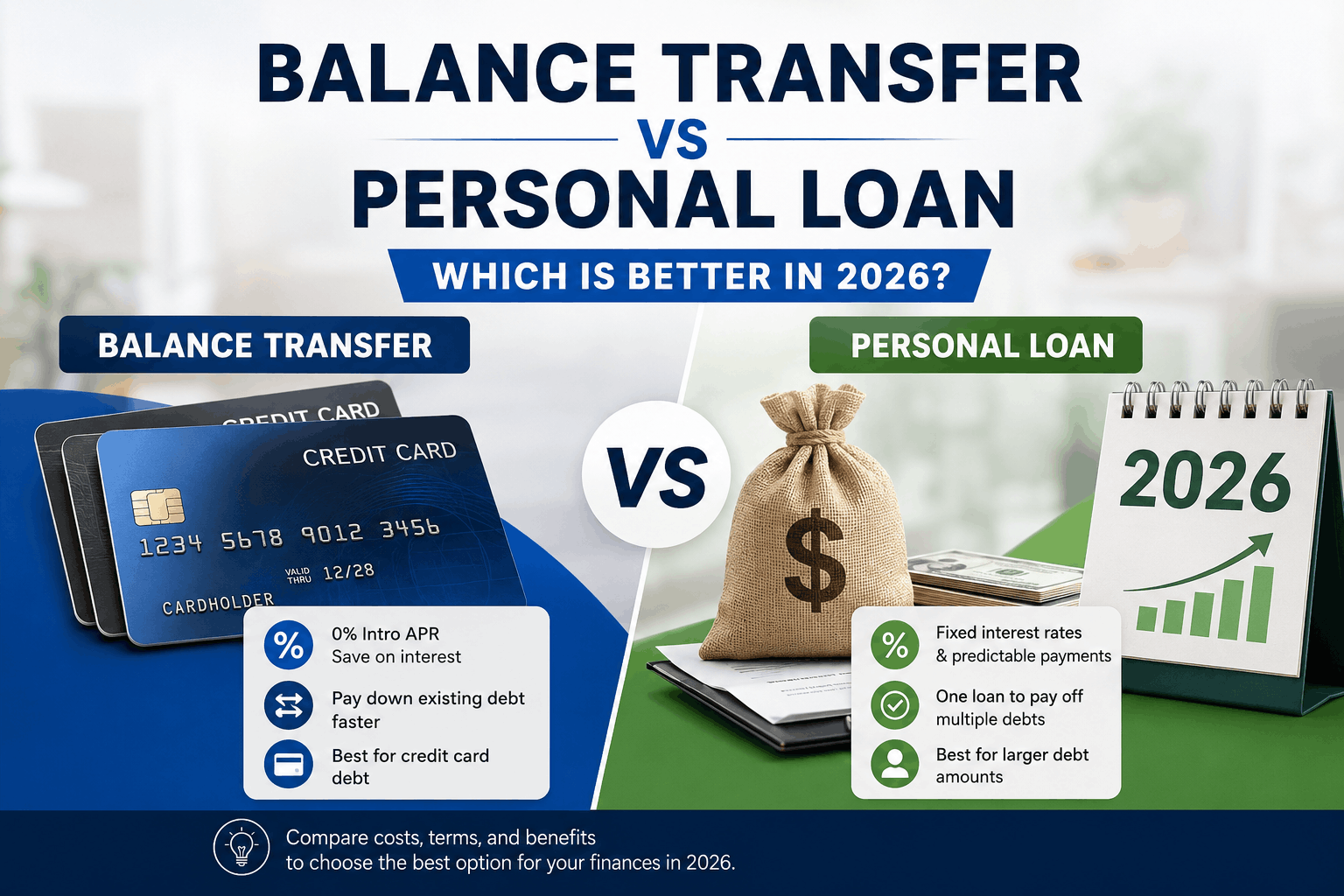
When you’re sitting on high-interest credit card debt, two options come up constantly: do a balance transfer or take out a personal loan. Both promise to lower your interest costs. Both have real advantages. And both have ways of going wrong that aren’t always obvious upfront.
The frustrating part is that the “right” answer genuinely depends on your specific situation — your credit score, the size of your debt, how disciplined you can be with an open credit line, and how long you realistically need to pay it off. This guide breaks down both options clearly so you can make an informed decision, not just pick whichever one sounds better.
Table of Contents
Quick Answer: Balance Transfer vs Personal Loan
| Factor | Balance Transfer | Personal Loan |
|---|---|---|
| Best interest rate possible | 0% (promo period) | ~7–12% (excellent credit) |
| Credit score needed | 670+ for best offers | 640+ for competitive rates |
| Repayment structure | Flexible (minimum payments) | Fixed monthly payment |
| Upfront fee | 3–5% transfer fee | 0–8% origination fee |
| Risk of overspending | Higher (open credit line) | Lower (lump sum, closed) |
| Best for | Motivated payoff in 12–21 months | Larger debt, longer timeline |
| Debt consolidation simplicity | Moderate | High |
Short answer: A balance transfer wins on cost — but only if you can pay off the balance before the promo period ends. A personal loan wins on structure and predictability, especially for larger debts or if you need more than 21 months to pay off.
What’s the Actual Difference Between These Two?
They solve the same problem — high-interest debt — through different mechanisms.
A balance transfer moves your existing credit card debt onto a new card, usually one offering 0% APR for a promotional period (typically 12–21 months). After that window closes, the remaining balance starts accruing interest at the card’s regular APR, which often ranges from 18% to 28%.
A personal loan gives you a lump sum of cash at a fixed interest rate, which you use to pay off your credit cards. You then repay the loan in fixed monthly installments over a set term — usually 24 to 60 months. The rate is fixed, meaning it doesn’t change, and there’s no temptation from an open credit line sitting there.
Neither is universally better. The right choice depends on how much you owe, your credit profile, your timeline, and honestly — how well you know yourself as a borrower.
When a Balance Transfer Makes More Sense
The Math Advantage Is Real
If you can pay off your balance within the 0% promotional window, a balance transfer is almost always the cheaper option. The only cost is the upfront transfer fee — usually 3–5% of the amount transferred.
Compare that to a personal loan at even 9% APR over 24 months, and the balance transfer wins clearly on interest paid — provided you actually clear the balance in time.
Best for: Organized borrowers with moderate debt
If your total balance is $3,000–$8,000 and you’re confident you can pay it down within 15–18 months by making fixed monthly payments (on your own, without the structure of a loan), a balance transfer is a strong option.
Downsides to be honest about
The 0% rate only lasts during the promo period. After that, you’re looking at regular APR — and if a large balance remains, the interest can catch up fast. The minimum payments on a balance transfer card are typically low, which sounds helpful but actually extends the payoff timeline and increases what you’ll owe overall.
There’s also the behavioral risk. Your old credit cards now have zero balances. That’s a lot of available credit sitting open, and a lot of people end up running those cards back up while still paying down the transferred balance. When that happens, the balance transfer made things worse, not better.
Who should avoid it: Anyone who tends to carry balances on multiple cards, has a debt amount that can’t realistically be paid off in the promo window, or has had trouble making consistent payments in the past.
When a Personal Loan Makes More Sense
Structure Over Savings
A personal loan doesn’t offer 0% interest. But what it does offer is structure — a fixed payment, a defined payoff date, and no temptation from an open revolving credit line.
If you owe $15,000 across multiple cards and it’s going to take you 3–4 years to pay it off, a personal loan at 11% APR is dramatically better than staying at 24–27% on your credit cards. The transfer option becomes less viable here because 0% promos max out around 21 months, and the balance would still be substantial when the regular APR kicks in.
Best for: Larger balances and longer payoff timelines
Personal loans are particularly effective for debt consolidation when you have multiple accounts. One loan, one payment, one payoff date. That simplicity reduces the chance of missing a payment, and the fixed structure makes budgeting straightforward.
Downsides to acknowledge
Personal loans often come with origination fees — typically 1–8% of the loan amount — which reduce how much of the loan actually reaches your creditors. Some lenders deduct this from the loan amount before disbursing it, which means you may receive less than you expected.
The interest rate also depends heavily on your credit score. The advertised rate (the one on the front page of any lender’s site) usually requires excellent credit — typically 740 or above. If your score is in the 640–680 range, your actual rate could be significantly higher. Getting a quote doesn’t hurt your score if the lender uses a soft inquiry, but always confirm before proceeding.
Who should avoid it: People who have excellent credit and a small enough balance to pay off in 12–18 months. In that case, a 0% balance transfer almost always wins on total cost.
Real-World Cost Comparison: $8,000 in Debt
Let’s make this concrete. You have $8,000 in credit card debt at 25% APR.
Option A: Balance Transfer (0% for 18 months, 3% fee)
| Detail | Amount |
|---|---|
| Upfront transfer fee (3%) | $240 |
| Monthly payment to clear in 18 months | ~$444 |
| Interest paid during promo | $0 |
| Total cost if paid off in time | $240 |
| Remaining balance if only minimums paid | $5,000+ exposed to 22% APR |
Option B: Personal Loan (11% APR, 36 months, 2% origination fee)
| Detail | Amount |
|---|---|
| Origination fee (2%) | $160 |
| Monthly payment | ~$262 |
| Total interest over 36 months | ~$1,390 |
| Total cost | ~$1,550 |
Option C: Do Nothing (stay at 25% APR, pay $262/month)
| Detail | Amount |
|---|---|
| Monthly payment | $262 |
| Time to pay off | ~48 months |
| Total interest paid | ~$4,560 |
| Total cost | ~$4,560 |
These are illustrative estimates using standard amortization logic. Actual results vary based on your specific rate, payment behavior, and issuer terms.
The takeaway: if you can make the ~$444/month payment and clear the balance in 18 months, the balance transfer costs you only $240. If you can’t maintain that pace, the personal loan at 11% saves you over $3,000 compared to staying put — even though it’s not a 0% offer.
Hidden Fees and Fine Print That Matter
Balance Transfer — What to Watch
Penalty APR. Miss one payment and many issuers will cancel your promotional rate immediately, jumping to a penalty APR that can hit 29–33%. The promo disappearing after one mistake is the single biggest financial risk with balance transfers.
Transfer fee timing. The fee applies the moment the transfer is processed — before you’ve saved a dollar. On large balances, that upfront cost is significant.
The promo clock. It starts at account opening, not transfer completion. If your transfer takes two weeks to process, you’ve already lost that time from your promo window.
New purchase rates. Some cards apply 0% to transferred balances only. Any new purchases immediately accrue the regular APR, often without a grace period. Check this before using the card for anything else.
Personal Loan — What to Watch
Origination fees deducted at funding. If you take a $10,000 loan with a 5% origination fee, you may only receive $9,500. Make sure you borrow enough to cover your actual debt.
Prepayment penalties. Some lenders charge a fee if you pay off the loan early. This is less common now but worth checking — especially if your financial situation might improve and you’d want to accelerate payoff.
Variable rate personal loans. Most personal loans are fixed rate, but not all. A variable rate loan might start lower but can increase over time. Stick with fixed rate for predictability.
Impact on credit utilization. Paying off credit cards with a personal loan reduces your revolving utilization — which can improve your credit score. A balance transfer doesn’t lower your utilization since the debt moves to another revolving account.
Common Mistakes With Both Options
Choosing without running the numbers. The balance transfer sounds free (0%!) and the personal loan sounds expensive (11%!). But that math ignores your actual payoff timeline. Always calculate total cost, not just the headline rate.
Not comparing lenders for personal loans. Rates vary significantly between banks, credit unions, and online lenders. Credit unions in particular often offer lower personal loan rates than major banks, especially for members with fair credit. Getting two or three quotes costs nothing if lenders use soft pulls.
Leaving old credit cards open with no plan. Once the debt is moved or paid off, those cards are sitting at zero. Without a clear decision about how to handle them — close them, freeze them, or keep them open with zero balance for utilization purposes — most people find a way to run them back up.
Ignoring the credit score requirement gap. A balance transfer at 0% requires good credit. A personal loan at a reasonable rate requires decent credit. If you apply for something you don’t qualify for, you’ve taken a hard inquiry hit with nothing to show for it. Check pre-qualification offers first.
Treating debt consolidation as debt elimination. Moving debt around doesn’t reduce it. The underlying balance is still there. Both tools only work if the behavior that created the debt has also changed.
Who Should Avoid Each Option
Avoid a balance transfer if:
- Your debt total can’t realistically be cleared within the promo period
- You have a history of missed or late payments
- Your credit score is below 650 (approval odds for good transfer offers drop significantly)
- You’re planning to apply for a mortgage or auto loan within 6–12 months
- You know you’ll continue using the freed-up credit on the old cards
Avoid a personal loan if:
- Your debt is small and you can pay it off quickly — the transfer fee beats loan interest in that scenario
- You have excellent credit and access to strong 0% offers — why pay interest when you don’t have to?
- The origination fee is high and the rate barely beats your credit card — the math may not work out
- You need flexibility in payment amounts month to month
How to Decide: A Simple Decision Framework
Work through these four questions:
1. Can you pay off the full balance within 18 months? If yes and your credit qualifies — balance transfer is likely cheaper. Calculate the required monthly payment and be realistic about whether you’ll make it.
2. Is your total debt above $10,000? Larger balances usually favor personal loans. The 21-month maximum on promo periods often isn’t enough runway, and the structure of a fixed loan helps with larger consolidations.
3. Is your credit score above 700? If yes, you’ll likely qualify for both options at competitive rates. Run the numbers on total cost for each and compare.
4. Have you struggled with credit card discipline before? If yes, the personal loan removes the behavioral risk of an open revolving line. Sometimes the slightly higher cost is worth the guardrails.
A useful secondary check: contact your current card issuers before applying for anything. The CFPB has consistently noted that cardholders often receive rate reductions simply by calling and asking. It won’t always work, but it takes five minutes and doesn’t touch your credit score.
Frequently Asked Questions
Does a balance transfer or personal loan hurt your credit score more? Both create a hard inquiry when you apply. A balance transfer opens a new revolving account; a personal loan adds an installment account. Personal loans can actually benefit your credit mix if you only have revolving accounts. The balance transfer may have a short-term negative effect on utilization if you’re using a large portion of the new card’s limit.
Can you do both — a balance transfer and a personal loan? Yes, though it gets complicated. Some people use a balance transfer for one portion of their debt and a personal loan for another. The logic can work, but it adds accounts, inquiries, and complexity. Most people are better served by picking one approach.
Which is faster to access the funds? Personal loan funds can arrive in 1–3 business days with online lenders. Balance transfers take 5–14 business days to process. Keep making minimum payments on your old cards until everything clears.
What credit score do you need for a personal loan at a good rate? According to Experian’s scoring models, rates become meaningfully competitive around 670+. Borrowers with scores above 720 typically access the lowest rates. Below 640, personal loan rates can exceed 20%, which may not offer enough savings over your current credit cards.
Is a debt management plan a better option than both? For some people, yes. A nonprofit credit counseling agency can negotiate reduced interest rates — sometimes to 6–8% — without requiring good credit. It’s worth exploring if your credit score doesn’t qualify you for competitive transfer or loan rates.
Final Thoughts
Neither option is objectively better. They’re tools, and the right tool depends on your specific debt, your credit profile, your timeline, and how well you’ll manage an open line of credit versus a fixed payment.
The balance transfer is the cheaper option on paper — but only if you use the promo window effectively and don’t accumulate new debt on the old cards. The personal loan costs more in interest but offers structure, simplicity, and a guaranteed end date.
If you’re organized, motivated, and have good credit, the balance transfer can be a smart short-term move. If your debt is substantial, your timeline is longer, or you’ve been burned by revolving credit before, the predictability of a personal loan is worth the extra cost.
Either way, the act of making a deliberate choice — instead of just continuing to pay 25% APR on credit cards indefinitely — is already a meaningful step in the right direction.