

Every few months, someone in my life asks me some version of the same question.
A neighbor: “I’ve got about $5,000 on a card that’s killing me with interest. Is there a card where I just… don’t pay interest for a while?”
A former coworker: “I need to replace my HVAC. It’s $4,200. I don’t want to put it on my 27% APR card. Is there a better option?”
My brother-in-law, literally last month: “I keep seeing ads for 0% cards. Are they actually real or is it a trap?”
The answers, in order: yes, absolutely yes, and — it depends on whether you read the fine print.
No-interest credit cards are real. They work. And in 2026, there are more solid options than ever. But “which one should I get” isn’t a question with a universal answer. The best card for someone with $12,000 in debt and 24 months to pay it off is completely different from the best card for someone financing a $3,000 bathroom renovation.
That’s what this comparison is actually about. Not just a table of numbers — though we’ll do that too — but a real breakdown of who each card is built for, where the hidden costs live, and how to avoid the mistakes I’ve watched smart people make over and over.
Let’s go.
Table of Contents
First: What “No Interest” Actually Means in 2026
Quick foundation before we get into comparisons, because this still trips people up.
No such thing as a permanently interest-free credit card from a major US issuer. What you’re looking at is a 0% introductory APR — a promotional window, typically ranging from 12 to 21 months, during which the card charges zero interest on a covered balance. After that window closes, the regular variable APR kicks in on whatever you still owe.
Two types of balances can be covered:
Purchases: New things you buy with the card. Great for financing a planned expense — medical bill, home repair, appliance replacement — without paying interest while you pay it down.
Balance transfers: Existing debt you move from a high-interest card onto the 0% card. Every dollar you pay goes directly toward principal instead of partly disappearing into interest charges.
Some cards offer 0% on both. Some have different promotional windows for each. And the regular APR that kicks in afterward — anywhere from 17% to 30% depending on the card and your credit — is the cliff you need to avoid falling off.
That’s the whole structure. Now let’s compare the cards that actually matter.

The Cards We’re Comparing
For 2026, these are the most relevant no-interest credit cards for the 25–45 age bracket dealing with debt consolidation or big-ticket financing:
- Citi Simplicity Card
- Wells Fargo Reflect Card
- Discover it Balance Transfer
- Chase Freedom Unlimited
- American Express Blue Cash Everyday
- Citi Diamond Preferred
- BankAmericard Credit Card
- US Bank Visa Platinum
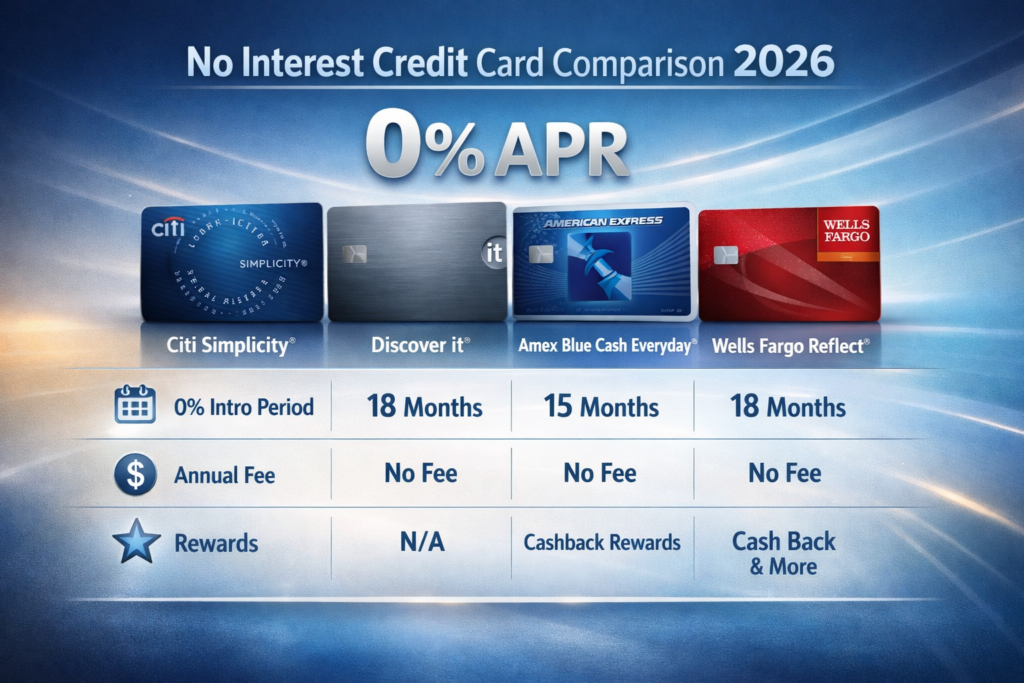
All no annual fee. All offering at least 15 months of 0% APR on either purchases, balance transfers, or both.
The Master Comparison Table
| Card | 0% BT Period | 0% Purchase Period | BT Fee | Regular APR (approx.) | Annual Fee | Rewards |
|---|---|---|---|---|---|---|
| Wells Fargo Reflect | 21 months | 21 months | 5% (min $5) | 17.74%–29.74% | $0 | None |
| Citi Simplicity | 21 months | 12 months | 5% (min $5) | 18.24%–28.99% | $0 | None |
| Citi Diamond Preferred | 21 months | 12 months | 5% (min $5) | 17.99%–27.99% | $0 | None |
| Discover it Balance Transfer | 18 months | 6 months | 3% intro, then 5% | 17.24%–28.24% | $0 | Yes — 5%/1% + Cashback Match |
| BankAmericard | 18 months | 18 months | 3% intro | 15.99%–25.99% | $0 | None |
| Chase Freedom Unlimited | 15 months | 15 months | 5% (min $5) | 19.99%–28.74% | $0 | Yes — 1.5–5% cash back |
| Amex Blue Cash Everyday | 15 months | 15 months | 3–5% (verify) | 19.24%–29.99% | $0 | Yes — 3%/1% cash back |
| US Bank Visa Platinum | 18 months | 18 months | 3% (min $5) | 17.99%–27.99% | $0 | None |
Rates and terms as of 2026. Always verify current offers directly with the issuer before applying — promotional terms change.
Now Let’s Actually Break This Down
A table is useful. But it doesn’t tell you that one card’s balance transfer process is notoriously clunky while another’s is seamless. It doesn’t tell you that “21 months” means nothing if you can’t get approved for a sufficient credit limit. And it definitely doesn’t tell you which card is right for your specific situation.
So let’s go category by category.
Longest 0% Window: Who Wins for Maximum Debt Payoff Time
Winner: Wells Fargo Reflect, Citi Simplicity, Citi Diamond Preferred — all tied at 21 months
If your single priority is the most time to pay off a balance transfer without interest, these three cards are your top tier. Twenty-one months is the longest promotional period currently available from any major no-annual-fee issuer.
Wells Fargo Reflect is the standout here for one reason the table doesn’t capture: it’s the only card in this comparison that offers 21 months on both purchases AND balance transfers. Citi Simplicity and Diamond Preferred give you 21 months on balance transfers but only 12 months on purchases. If you’re also planning to finance new spending alongside a debt payoff, Reflect is the only card that covers both comprehensively.
Citi Simplicity and Citi Diamond Preferred are nearly identical products. Both offer 21 months on balance transfers, 12 months on purchases, no annual fee, and no rewards. The main functional difference: Citi Simplicity has no late fees (though it can still apply penalty APR for late payments), while Diamond Preferred does charge them. If you’re prone to occasional late payments, Simplicity has slightly more forgiveness — though both can still revoke your promotional rate if you’re significantly delinquent.
The honest caveat on all three: The 5% balance transfer fee is real. On a $10,000 transfer, that’s $500 out of pocket before you’ve made a single payment. And none of these three cards earns a dollar in rewards — ever. Once your debt is paid off, they become fairly inert cards to carry.
Best Balance Transfer Fee: Who Charges You the Least to Move Your Debt
Winner: Discover it Balance Transfer and BankAmericard Credit Card (tied at 3% intro)
This is an underappreciated factor in the 0% card decision, especially for people moving larger balances.
The difference between a 3% and 5% balance transfer fee on a $10,000 transfer is $200. On a $15,000 transfer, it’s $300. That’s real money, and it’s paid upfront — before you’ve even started paying down the balance.
Discover it Balance Transfer charges a 3% intro transfer fee for transfers made within the promotional window after account opening. After that initial period, it bumps to 5%. So you need to move fast — but if you do, you’re saving meaningfully on fees compared to Citi’s 5%.
BankAmericard also offers a 3% intro balance transfer fee — and pairs it with an 18-month 0% window on both purchases and balance transfers. That’s a genuinely competitive combination that doesn’t get enough attention. No rewards, but if you want a longer window than Chase or Amex with a lower fee than Citi, BankAmericard deserves a hard look.
US Bank Visa Platinum also offers a 3% transfer fee with 18 months on both purchases and balance transfers. Similar positioning to BankAmericard — solid, underrated, no rewards.
If your primary concern is minimizing upfront transfer costs while still getting a meaningful interest-free window, these three cards beat the field on fee efficiency.
Best for Everyday Rewards Alongside Debt Payoff
Winner: Discover it Balance Transfer (year one), Chase Freedom Unlimited (long-term), Amex Blue Cash Everyday (category-specific)
Here’s where the pure balance-transfer-only cards fall behind. Citi Simplicity, Wells Fargo Reflect, Citi Diamond Preferred, BankAmericard, US Bank Visa Platinum — none of them earn a single point or cent in cash back. They’re tools for one job. Once that job is done, they don’t do much else.
If you want a 0% card that also works as a long-term everyday card, you’re looking at three options:
Discover it Balance Transfer is hard to beat in year one purely because of the Cashback Match. Every dollar of cash back you earn during your first 12 months gets doubled by Discover at year-end — automatically, with no cap. If you earn $250 through normal spending, you walk away with $500 at year-end. The 5% rotating categories (groceries, gas, Amazon, restaurants — varies by quarter) require quarterly activation but are legitimately valuable. The catch: only 6 months of 0% on purchases, and the 18-month BT window is shorter than Citi’s 21.
Chase Freedom Unlimited is the best all-around long-term card in this group. Fifteen months of 0% on both purchases and transfers — not the longest — but the rewards program stays useful forever. Unlimited 1.5% on everything, 3% on dining and drugstores, 5% on Chase travel. No activation required, no rotating categories. If you have or plan to get a Chase Sapphire card later, CFU points transfer over at higher value. The 5% BT fee is the main cost drawback.
Amex Blue Cash Everyday is the specialist pick. If your monthly spending is heavy on groceries, gas, and online shopping, 3% back in those categories with no annual fee is hard to beat. The 15-month 0% window is the same as CFU. The balance transfer process is less streamlined and the regular APR ceiling (up to 29.99%) is the highest in this comparison.
My honest ranking for rewards alongside 0% financing: Discover it wins year one, CFU wins long-term for general spenders, Amex BCE wins for grocery/gas/online category spenders.
Best for Purchases Specifically (Not Balance Transfers)
Winner: Wells Fargo Reflect (21 months), BankAmericard / US Bank Visa Platinum (18 months each)
If you’re planning a big purchase — HVAC replacement, bathroom remodel, medical procedure — and you want the longest possible runway to pay it off interest-free, the ranking looks like this:
- Wells Fargo Reflect — 21 months on purchases. The longest available, full stop.
- BankAmericard — 18 months on purchases, 3% BT fee if you also need that.
- US Bank Visa Platinum — 18 months on purchases, same competitive positioning.
- Citi Simplicity / Diamond Preferred — 12 months on purchases only. Solid for BT, underwhelming for purchases.
- Chase Freedom Unlimited / Amex BCE / Discover it Cash Back — 15 months on purchases with rewards attached.
If the goal is purely “I need to finance a $5,000 home repair interest-free for as long as possible,” Wells Fargo Reflect is the most logical answer. No rewards, no annual fee, just the longest possible interest-free runway on new spending.
Best for Credit Score Protection During Payoff
This is an angle most comparisons skip, but it matters.
When you do a balance transfer, you’re potentially opening a new account (hard inquiry on your credit report) and moving a significant balance. How you manage this affects your credit score during the payoff period.
A few things to keep in mind across all these cards:
Don’t close the card you transferred from. Closing an old account reduces your total available credit and increases your overall utilization ratio — both negatively impact your score. Move the balance, cut the card, leave the account open.
Keep utilization below 30% on the new card. If your credit limit on the new card is $6,000 and you transfer $5,800, your utilization on that card is ~97%. That will hurt your score even if you’re paying it down. If your limit is sufficient to keep the transferred balance under 30% utilization, great. If not, it’s something to be aware of.
On-time payments protect both your score and your promo rate. Every card in this comparison will let you down if you miss payments — both by potentially revoking the 0% offer and by dinging your credit score.
Cards with a longer promotional window give you more time to manage utilization. As you pay down the balance over 18–21 months, your utilization improves gradually. A 21-month window means 21 months of gradual score improvement as the balance shrinks.
Who Has the Most Streamlined Balance Transfer Process
This is the behind-the-scenes factor that matters more than most people realize until they’re mid-process.
Most reliable/streamlined: Citi, Discover, Chase
Less standardized: American Express, Wells Fargo (occasional reports of process friction)
With Citi (Simplicity, Diamond Preferred), Discover, and Chase, you can typically initiate a balance transfer online during or immediately after the application process. It’s clear, documented, and predictable.
American Express has more variability — not all approved accounts have balance transfer functionality, the process sometimes requires phone calls, and limits can be more restrictive. Not impossible, but more friction.
Wells Fargo has generally been reliable but has had occasional customer-reported issues with transfer processing times. Anecdotal, but worth knowing.
If you’re doing your first balance transfer and want the simplest experience, Citi or Discover is the cleaner path. Both have well-documented online transfer processes.
Head-to-Head Matchups for Specific Situations
Let’s make this concrete. Real scenarios, real recommendations.
Situation 1: $8,000 in Credit Card Debt, Need Maximum Time
Best pick: Citi Simplicity or Citi Diamond Preferred
21 months. No annual fee. No rewards to distract you from the mission. $8,000 ÷ 20 months (with one buffer month) = $400/month. If you can hit that number, Citi gives you the longest runway available.
Transfer fee: $400 (5% of $8,000). Regular APR after promo: 18–29%. Do not still have a balance at month 22.
Honorable mention: Wells Fargo Reflect if you also plan to finance some purchases during the payoff period.
Situation 2: $5,000 in Debt, Want to Save on the Transfer Fee
Best pick: Discover it Balance Transfer
3% transfer fee on $5,000 = $150. Compared to Citi’s 5% = $250. You save $100 on the fee and get 18 months — enough runway for most people at $300+/month. Plus you earn cash back on everyday spending and get the Cashback Match at year-end.
The trade: you’re giving up 3 months of 0% compared to Citi. On $5,000 at $300/month, you’d pay it off in ~17 months anyway. So the shorter window rarely matters at this balance level.
Situation 3: $4,500 Home Improvement, New Purchase (Not a Transfer)
Best pick: Wells Fargo Reflect or BankAmericard
21 months and 18 months respectively, both on purchases. $4,500 ÷ 20 = $225/month on Reflect. That’s very manageable.
If you want rewards too, Chase Freedom Unlimited (15 months) or Amex Blue Cash Everyday (15 months) are worth considering — the shorter window is fine for $4,500 if you’re paying $350+/month.
Situation 4: $12,000 in Debt, Needs Both Time and Lower Fee
Best pick: BankAmericard or US Bank Visa Platinum
This is the most underrated matchup in the comparison. Both offer 18 months AND a 3% intro transfer fee. On $12,000:
- BankAmericard fee: $360 (3%)
- Citi Simplicity fee: $600 (5%)
- You save $240 by going with BankAmericard
And $12,000 ÷ 17 months (with buffer) = ~$706/month. If that’s achievable, 18 months is enough. If $706 is too steep, Citi’s 21 months gives you more runway but costs more in fees. Run your own math.
Situation 5: Medical Bills + Want to Keep a Useful Long-Term Card
Best pick: Amex Blue Cash Everyday or Chase Freedom Unlimited
Both give 15 months on purchases and balance transfers. Both have no annual fee. Both earn solid ongoing rewards. And both are cards worth keeping after the debt is gone.
If you spend more at grocery stores and online: Amex BCE’s 3% in those categories wins. If you spend diversely and want simplicity: CFU’s 1.5% on everything wins.
Situation 6: Not Sure of Balance Size, Want Flexibility
Best pick: Wells Fargo Reflect
21 months on everything — purchases and balance transfers. No annual fee. It’s the most flexible single card for someone who doesn’t know exactly what they’ll use it for. Transfer a balance and finance a repair at the same time, all under one long 0% umbrella.
The downside: 5% BT fee and zero rewards. But for flexibility and maximum window, nothing beats it.
The Mistakes People Make With These Cards (And How to Avoid Them)
I’ve been writing about this long enough to have seen the same patterns repeat. Here are the ones that hurt people most:
Mistake 1: Transferring the balance and then not changing spending habits. You moved $6,000 off your old card. That card is now at a $0 balance. Within three months, it’s at $2,500 again. Now you have $6,000 on a 0% card AND $2,500 on a 22% card. You’ve made things worse. If you do a balance transfer, freeze the old card — literally put it in a drawer, or freeze it in a container of water if you have to.
Mistake 2: Not building a written payoff plan. “I’ll figure it out as I go” is how you arrive at month 16 with $3,000 still on a card that’s now charging you 26%. The plan is simple: take your balance, divide by (promo months minus one), and that’s your monthly payment target. Write it down. Put it in your budget. Set a calendar reminder.
Mistake 3: Applying for multiple 0% cards at once. I’ve seen people do this — apply for three or four cards simultaneously thinking they’ll compare offers after approval. Each application is a hard inquiry. Multiple hard inquiries in a short window signal financial distress to credit bureaus and can drop your score 10–20 points. Pick your card, apply once.
Mistake 4: Confusing the balance transfer window with the purchase window. These are often different lengths on the same card. Citi Simplicity gives you 21 months on a balance transfer but only 12 months on new purchases. If you charge $800 in new purchases and your purchase promo expires at month 12, those purchases start accruing interest — even while your transfer balance is still at 0%. Know both dates.
Mistake 5: Treating the 0% period as permission to spend more. The point of a 0% card is to eliminate existing debt faster or finance a necessary purchase affordably. It’s not a signal that you can spend more freely because “it’s all interest-free anyway.” The balance still exists. It still has to be paid. The clock is running.
Mistake 6: Closing the old card after transferring. Don’t do this. Your credit score depends partly on your total available credit. Closing an old account reduces that, increases your overall credit utilization ratio, and drops your score. Move the balance, cut the physical card, leave the account open and unused.
Quick Reference: Which Card for Which Situation
| Your Situation | Best Card | Why |
|---|---|---|
| Largest balance ($10K+), need max time | Citi Simplicity or Wells Fargo Reflect | 21 months BT |
| Large balance, want lower transfer fee | BankAmericard or US Bank Visa Platinum | 3% fee + 18 months |
| Mid-range balance ($3K–$7K), want rewards too | Discover it Balance Transfer | 3% fee + 18 months + Cashback Match |
| General spending rewards + decent 0% window | Chase Freedom Unlimited | 15 months + 1.5–5% cash back forever |
| Grocery/gas/online shoppers | Amex Blue Cash Everyday | 3% on those categories + 15 months |
| Big planned purchase, longest window | Wells Fargo Reflect | 21 months on purchases |
| Mid-size purchase, 18 months | BankAmericard or US Bank Visa Platinum | 18 months on purchases + low fee |
| Hate annual fees forever | Any card on this list | All $0 annual fee |
| First balance transfer, want simple process | Citi Simplicity or Discover it | Clean, documented process |
What to Check Before You Apply (The Pre-Application Checklist)
Before you fill out any application, run through this:
1. What’s your total balance or purchase amount? Write the exact number down. This determines whether 15, 18, or 21 months is enough.
2. What monthly payment can you realistically make? Balance ÷ (promo months – 1) = your monthly target. Be honest. Not what you hope to pay — what you will actually pay given your current budget.
3. Does the math work? If your balance is $9,000 and your monthly target works out to $500 and you can only make $350/month — the math doesn’t work. You need either a longer window (21 months → ~$470/month) or to reduce the balance before transferring.
4. What’s your credit score? All cards in this comparison generally require 670+, with better approval odds and lower post-promo APRs for 700+ scores. Check your score free through your current bank, credit card app, or AnnualCreditReport.com before applying.
5. What do you want from this card long-term? If you want to cancel it after payoff, pure balance-transfer cards (Citi Simplicity, Wells Fargo Reflect) are fine. If you want to keep it as an everyday earner, pick one with rewards.
6. Which fee math favors you? At what balance does 3% vs. 5% transfer fee justify the card switch? Run that calculation. For balances over $5,000, the fee difference becomes increasingly significant.
The Cards I’d Personally Choose in Each Scenario
I’ve done this long enough to have opinions. Here’s where I’d land if I were in each situation:
If I had $9,000 in credit card debt and needed serious time to pay it off — Citi Simplicity. Clean, long, no-fee, proven process. I’d pay the $450 transfer fee, build a 20-month payoff plan, and go heads-down until it’s done.
If I had $5,000 in debt and wanted the card to stay useful after — Discover it Balance Transfer. Lower fee, 18 months is enough at that balance level, and the Cashback Match in year one is genuinely good value. I’d keep it as my grocery/gas card afterward.
If I was financing a $6,000 kitchen renovation — Wells Fargo Reflect, no question. Twenty-one months on a purchase, no annual fee, and I can put materials and contractor deposits on it over several months without worrying about a short purchase window closing before I’ve even finished the project.
If I wanted one card that does everything — Chase Freedom Unlimited. The 15-month window is fine for most mid-range balances or purchases, the rewards program is genuinely useful long-term, and the Chase ecosystem adds value if I ever get a Sapphire card. It’s not the best at any single thing on this list. It’s just consistently good at all of them.
Conclusion + The Three Rules That Always Apply
After eight years of writing about this stuff, I’ve watched no-interest credit cards be the thing that genuinely helped someone get out of debt — and I’ve watched them be the thing that gave someone just enough breathing room to avoid fixing the real problem until it got worse.
The card itself doesn’t determine the outcome. The plan does.
If there are three things I’d want anyone reading this to take away:
Rule one: Run the numbers before you apply, not after. Your monthly payoff target is the most important number in this whole decision. Everything else — which card, which window, which fee — comes second.
Rule two: The transfer fee is a cost, not an emergency. Factor it in, choose the card that minimizes it for your balance size, but don’t let fear of the fee keep you paying 24% APR on a $7,000 balance. The math almost always favors the transfer.
Rule three: The clock starts when the account opens. Not when you feel ready. Not when you get around to transferring. The promotional window is running from day one. Move fast, plan immediately, and treat the end date like a hard deadline — because it is.
Get the right card for your situation. Build the plan. Work the plan.
That’s genuinely all it takes.
Frequently Asked Questions
Which no-interest credit card has the longest 0% APR period in 2026?
As of 2026, the longest 0% introductory APR periods available from major no-annual-fee cards are 21 months, offered by the Citi Simplicity Card, Citi Diamond Preferred, and Wells Fargo Reflect Card — all on balance transfers. Wells Fargo Reflect also provides 21 months on new purchases, making it the most comprehensive long-window option if you need both covered.
What’s the difference between 0% APR on purchases vs. balance transfers?
Purchase APR applies to new things you buy with the card — it covers new spending. Balance transfer APR applies to existing debt you move from another credit card onto the new card. Some cards offer different promotional windows for each, and the clock starts at different points. Always check both terms separately before applying.
What credit score do I need for a no-interest credit card?
Most 0% APR cards in this comparison require a FICO score of at least 670, with significantly better approval odds and potentially lower post-promo APRs for scores of 700 or higher. Below 650, it’s difficult to qualify for these products — focus on credit rebuilding first if that’s your situation.
Are balance transfer fees worth paying?
In most cases, yes — especially if you’re moving debt from a card charging 20% APR or higher. A 3–5% one-time fee is almost always cheaper than months of compound interest on a high-rate card. The exception is very small balances (under $1,500) where the interest savings don’t significantly exceed the fee, or if you have no realistic payoff plan within the promotional window.
What happens if I don’t pay off the balance before the 0% period ends?
Whatever balance remains when the promotional period closes gets charged interest at the card’s regular variable APR — which can range from roughly 17% to 30% depending on the card and your credit profile. There is no grace period extension. This is why building a payoff plan to finish one to two months before the promo ends is essential.
Can I do a balance transfer between cards from the same issuer?
No. Issuers don’t allow transfers between their own cards. You can’t move debt from one Citi card to another Citi card, or one Chase card to another Chase card. The balance you transfer must come from a card issued by a different financial institution.
Does opening a 0% APR card hurt my credit score?
Opening a new card causes a hard inquiry on your credit report, which typically causes a small, temporary score dip of 5–10 points. Your score will generally recover within 3–6 months of consistent on-time payments. The impact is modest for most people with established credit. Applying for multiple cards at once amplifies the impact — apply for one card at a time.
Which card has the lowest balance transfer fee?
Among major issuers in 2026, the lowest intro balance transfer fees are 3%, offered by the Discover it Balance Transfer, BankAmericard Credit Card, and US Bank Visa Platinum (on transfers made within the intro window). Citi cards, Wells Fargo Reflect, and Chase Freedom Unlimited typically charge 5%.
Should I close my old credit card after doing a balance transfer?
Generally, no. Closing an old account reduces your total available credit and increases your overall credit utilization ratio, both of which can lower your credit score. The better move is to stop using the old card, cut it up if temptation is an issue, but leave the account open. Exceptions exist — like if the old card has a high annual fee — but for most people, keeping it open costs nothing and protects your score.
Is it possible to do multiple balance transfers across different 0% cards?
Yes, and some people use this strategy — called “balance transfer surfing” — to keep debt at 0% across multiple promotional windows. Each new card requires a new application (hard inquiry), a new balance transfer fee, and qualification. It can work if done deliberately, but it requires discipline and can become a way of continuously deferring the real problem rather than solving it. Approach with caution.
Which 0% APR card is best for someone financing a home improvement project?
For maximum time on new purchases, Wells Fargo Reflect (21 months) is the strongest option. For a shorter but rewards-earning alternative, Chase Freedom Unlimited or Amex Blue Cash Everyday (both 15 months) work well for home improvement spending that also earns cash back. If the home improvement costs are already on a high-interest card, the Discover it Balance Transfer or BankAmericard offer a combination of a decent transfer window and lower fees.
Do any no-interest credit cards offer both 0% APR and rewards?
Yes — three cards in this comparison offer both: Discover it Balance Transfer (5%/1% cash back + Cashback Match in year one), Chase Freedom Unlimited (1.5–5% cash back on everything), and American Express Blue Cash Everyday (3% at supermarkets, gas, and online retailers; 1% elsewhere). Pure balance-transfer cards like Citi Simplicity and Wells Fargo Reflect offer no rewards at all.
Disclaimer: Credit card terms, APRs, promotional periods, fees, and rewards structures change frequently. All information in this comparison reflects publicly available data as of 2026. Always verify current terms directly with each card issuer before applying. This article is for informational and educational purposes only and does not constitute financial or legal advice.