
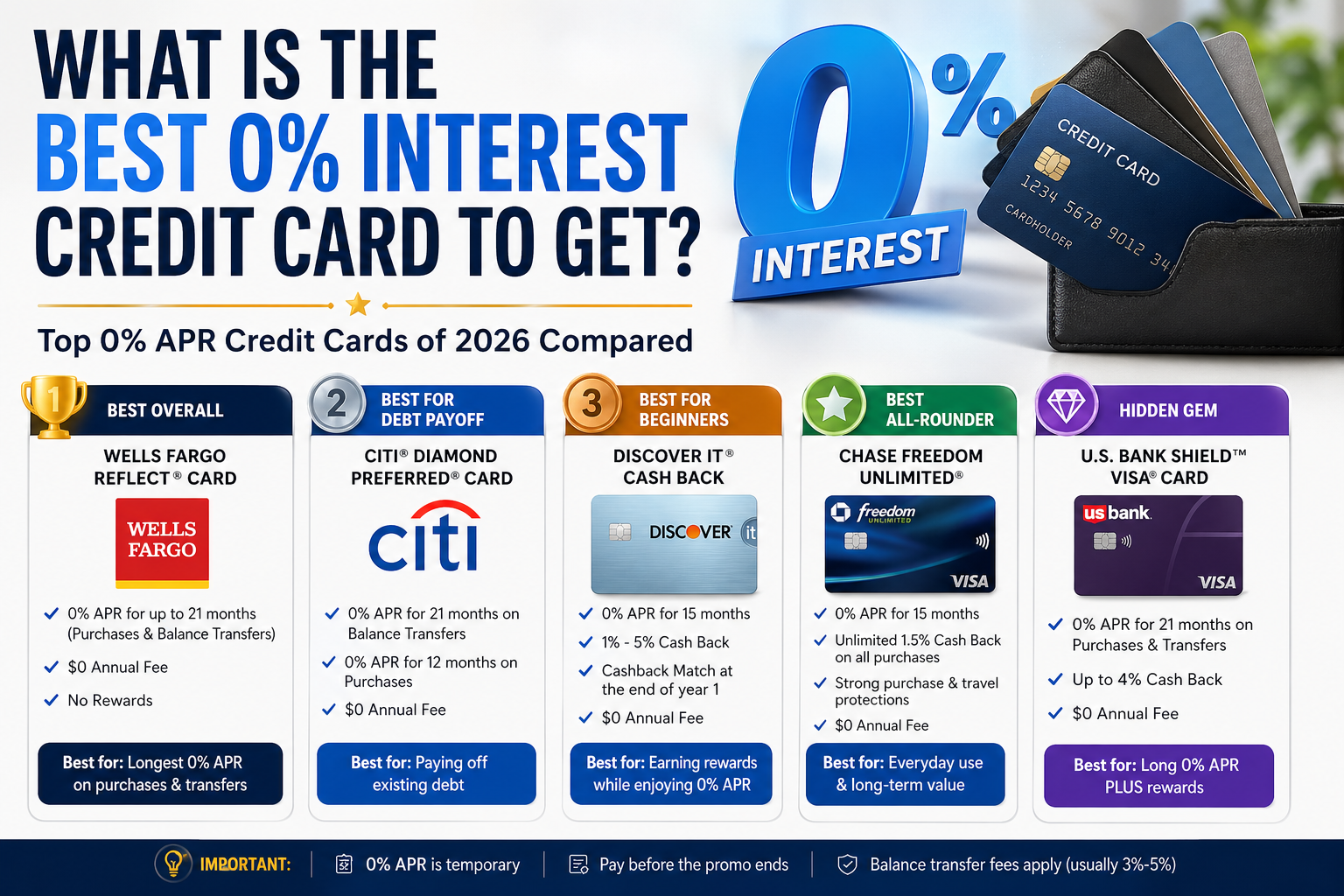
What Is the Best 0% Interest Credit Card to Get? (Honest Answer for Beginners)
Let me be upfront with you. When I first started looking into 0% interest credit cards, I was completely overwhelmed. There were dozens of options, all promising “the best deal,” and I had no idea what half the terms even meant. Introductory APR? Balance transfer fee? Annual fee waiver? It felt like reading a different language.
If you’re in that same boat right now — curious about 0% interest credit cards but not totally sure where to start — this is for you. I’m going to cut through the noise and actually help you understand what to look for, which cards are genuinely worth considering, and what most beginners get wrong.
Table of Contents
First, What Even Is a 0% Interest Credit Card?
Here’s the simple version: a 0% interest credit card (also called a 0% APR credit card) lets you carry a balance without being charged interest — but only for a limited time. That period is called the introductory APR period, and it usually lasts anywhere from 12 to 21 months depending on the card.
After that period ends? The interest rate jumps — often to 20%, 25%, or even higher. So yes, these cards are genuinely useful, but only if you actually have a plan.
Think of it this way: imagine you need to buy a new laptop for $1,200. You don’t have the full amount right now, but you know you’ll have it over the next year. A 0% interest credit card lets you put that $1,200 on the card today, spread the payments out over 12 months, and pay zero in interest. That’s real money saved — possibly $200 or more compared to a regular credit card.
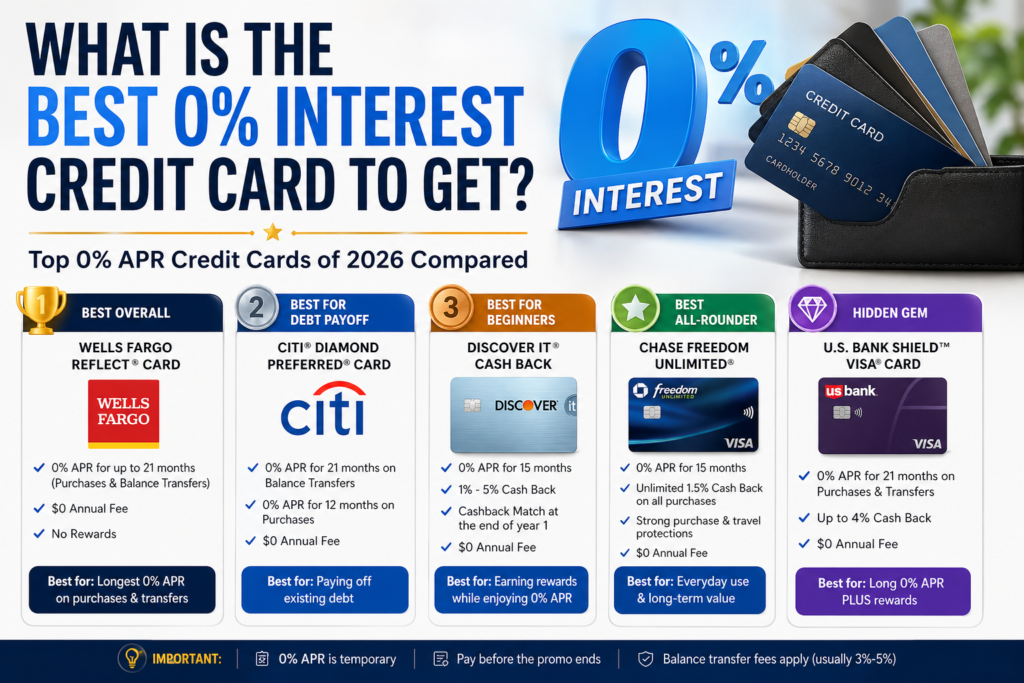
The Best 0% Interest Credit Cards Right Now
Okay, let’s get into the actual cards. I’m not going to list twenty options and confuse you. Here are the ones that genuinely stand out — especially for beginners.
1. Wells Fargo Reflect® Card — Best for the Longest 0% Period
If your main goal is to give yourself as much breathing room as possible, the Wells Fargo Reflect card is hard to beat. It offers up to 21 months of 0% intro APR on purchases and qualifying balance transfers. That’s one of the longest windows available anywhere right now.
There’s no annual fee, which is always a good sign for beginners. The only real catch is that after the intro period, the variable APR can be on the higher side. So treat this card like a tool, not a long-term credit strategy. Use the 21 months, pay off what you owe, and you’re golden.
2. Citi Double Cash® Card — Best if You Also Want Rewards
What most people don’t realize is that some 0% interest cards also give you cashback rewards. The Citi Double Cash card offers 0% intro APR for 18 months on balance transfers, and you earn 2% cash back on everything — 1% when you buy, 1% when you pay it off.
This one makes more sense if you’re doing a balance transfer (moving debt from a high-interest card to this one). There is a 3% balance transfer fee upfront, but when you compare it to months of high interest charges, it almost always works out in your favor.
3. Chase Freedom Unlimited® — Best All-Rounder for Beginners
Chase Freedom Unlimited might honestly be the card I’d hand to someone just starting out. It gives you 0% intro APR for 15 months on purchases and balance transfers, plus solid ongoing rewards: 1.5% cash back on most purchases, and higher rates on things like dining and drugstores.
It also comes with no annual fee. Chase has a pretty good app, their customer service is decent, and the card is widely accepted. Nothing flashy, but it just works — and for a beginner, “works well” beats “technically best” every time.
4. Discover it® Cash Back — Best for Building Credit Simultaneously
If you’re a beginner who’s also trying to build or improve your credit score at the same time, Discover it Cash Back is worth a serious look. It offers 0% intro APR for 15 months, has no annual fee, and Discover is actually known for being friendly toward people who are newer to credit.
What I personally like about this card is the rotating 5% cash back categories — things like gas stations, grocery stores, and Amazon. In the first year, Discover matches all the cash back you’ve earned. That’s a genuinely nice bonus, not just marketing fluff.
What Most Beginners Get Wrong About These Cards
Here’s where I want to be honest with you, because a lot of articles skip this part.
Mistake #1: Treating the 0% period like free money forever.
It’s not. It’s a window. People get excited, overspend, and then when the 21 months are up they’re sitting on a balance they can’t pay off — now charging 24% interest. That’s how a smart financial tool turns into a debt trap. Before you open one of these cards, have a rough plan. Know approximately what you’re going to charge and how you’re going to pay it down.
Mistake #2: Missing a payment.
This one stings. On some cards — not all, but some — missing even one payment can cause the card issuer to cancel your 0% intro rate early. You’d then be charged the regular APR going all the way back, or at minimum moving forward at the full rate. Always set up autopay for at least the minimum payment. Non-negotiable.
Mistake #3: Ignoring the balance transfer fee.
If you’re moving debt from another card, the 0% deal sounds amazing. And it usually is! But there’s typically a fee of 3–5% of the amount transferred. On $5,000 of debt, that’s up to $250 upfront. Still almost always worth it compared to months of 20%+ interest, but you should go in knowing that number.
So, Which One Should You Actually Get?
Here’s my honest take:
- If you need the most time to pay something off → Wells Fargo Reflect (21 months is hard to beat)
- If you have existing high-interest credit card debt → Citi Double Cash (balance transfer + rewards)
- If you’re new to credit cards and want something simple → Chase Freedom Unlimited
- If you’re also building credit from scratch → Discover it Cash Back
In reality, most beginners will do just fine with either Chase Freedom Unlimited or Discover it. Both are forgiving, well-designed cards that reward responsible use.
A Quick Word on Approval
One thing nobody tells you clearly upfront: to get approved for the best 0% interest credit cards, you generally need a good to excellent credit score — typically 670 or higher. If your credit score isn’t there yet, you might get approved for a card with a shorter intro period or a lower credit limit.
That’s okay. Don’t apply for five cards at once trying to find one that accepts you — every application causes a small dip in your credit score. Instead, check if you’re pre-qualified (most banks let you do a soft check that doesn’t affect your score) before you actually apply.
The Bottom Line
A 0% interest credit card, used correctly, is genuinely one of the most useful financial tools available. You can finance a big purchase without paying interest, consolidate existing debt, or just give yourself a cushion during a tight few months — all without a single dollar in interest charges.
The best card isn’t necessarily the one with the longest 0% period or the fanciest rewards. It’s the one that fits your situation, that you can actually manage responsibly, and that doesn’t come with an annual fee eating into your savings.
Start simple. Know your plan before you swipe. And whatever you do, don’t let the intro period expire with a balance you can’t handle.
That’s really it. The best 0% interest credit card is the one you’ll actually use wisely.
Always review the latest terms directly on the card issuer’s website before applying, as rates and offers can change.