
Let me guess. You’ve got a big purchase coming up — maybe a new laptop, a medical bill you didn’t see coming, or you’re just tired of watching interest eat away at your paycheck every month. You’ve heard about 0% interest credit cards, but you’re not sure which one is actually worth getting, or if the whole thing is even legit.
It’s legit. And if you pick the right card, it can genuinely save you hundreds of dollars. But there are a few things most people don’t realize before they apply — and I’ll get to those too.
First, What Even Is a 0% APR Card?
Really quickly, for anyone who’s never dealt with this before: APR stands for Annual Percentage Rate. It’s basically the interest the bank charges you on any balance you carry on your card. Normally, credit cards charge somewhere between 18% and 30% APR — which is brutal if you’re trying to pay off a $2,000 purchase over several months.
A 0% intro APR card gives you a window — usually between 12 and 24 months — where you pay zero interest. Nothing. The balance just sits there, and you chip away at it on your own schedule without the bank taking a cut.
That’s the deal. And right now, in 2026, some of these offers are genuinely impressive.
So, What Is the Best 0% Interest Card Right Now?
If I had to pick just one card for someone starting from scratch, it would be the U.S. Bank Shield™ Visa® Card. Here’s why.
It currently offers 0% intro APR on purchases and eligible balance transfers for 24 full months. That is two years of zero interest. Think about that for a second. If you buy a $1,800 refrigerator today and the intro period is 24 months, you’d need to pay just $75 a month to clear the balance — with no interest added at all. That’s a manageable number for most people.
There’s no annual fee either, which matters. A lot of cards bury a $95 or $120 annual fee in the fine print, which quietly eats into the money you’re supposedly saving.
The downside? It’s not a flashy rewards card. Once the 0% period is over, you won’t be racking up airline miles or cash back at any impressive rate. But if your main goal is to avoid interest and get breathing room on a big expense — or to climb out of existing debt — this card does exactly that, and better than almost anything else on the market right now.
But What If You Also Want Rewards?
Fair point. Not everyone wants a plain-jane card with no perks. If you want 0% interest and some reward value, a couple of options actually work well together.
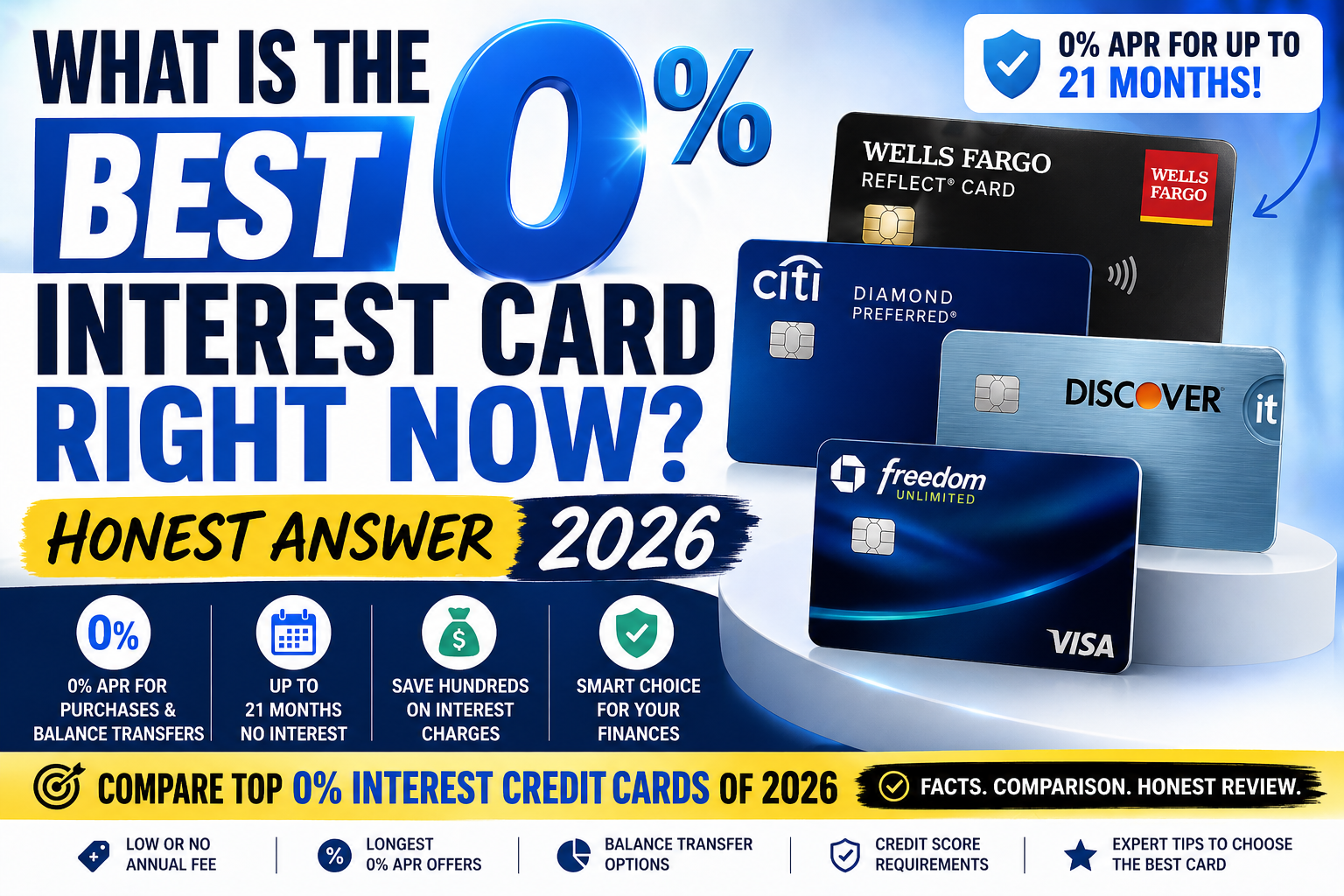
The Chase Freedom Unlimited® gives you 0% intro APR for 15 months on purchases and balance transfers, plus it earns 1.5% cash back on all purchases and 3% on dining and drugstores. No annual fee. The regular APR after the intro period runs between roughly 18% and 28% depending on your credit.
Fifteen months isn’t as long as 24, but it’s still a solid window. And if you’re someone who’s going to keep using the card after the intro period ends — for groceries, gas, everyday stuff — the cash back makes it useful long-term. In reality, this is probably the most “balanced” card for a beginner who doesn’t want to think too hard about it.
The Capital One VentureOne Rewards Credit Card is another one worth mentioning, especially if you travel occasionally. It has a 0% intro APR period and earns travel miles with no annual fee. It won’t compete with the 24-month offer on the U.S. Bank card, but if the idea of earning free flights while you pay off a purchase sounds appealing, it’s a decent pick.
The Two Longest 0% Offers Right Now
If the length of the intro period is your biggest priority, here’s where things stand:
U.S. Bank Shield™ Visa® — 24 months. Currently the longest offer widely available. No annual fee.
BankAmericard® Credit Card — 21 billing cycles on purchases and balance transfers. Also no annual fee. The regular APR after the intro period ranges from around 15% to 26%. Good card, solid reputation.
Wells Fargo Reflect® Card — 21 months from account opening. No annual fee. The balance transfer fee is 3% for the first four months, then goes up to 5% after that — something to watch if you’re transferring debt from another card.
Any of these three will give you a long runway. The choice between them mostly comes down to whether you’re making new purchases, moving existing debt, or both.
A Quick Story That Might Sound Familiar
A friend of mine — let’s call her Priya — had about $2,400 sitting on a high-interest card from a home renovation that went over budget. She was paying around $65 a month in interest alone. Not even touching the principal. Just feeding the bank.
She transferred the balance to a Wells Fargo Reflect card during a promotional period. The balance transfer fee was 3% — so about $72 upfront. But after that? Zero interest for 21 months. She set up automatic payments of $120 a month and paid the whole thing off in 20 months.
Total interest paid: zero. Compare that to what she would’ve spent staying on the original card — easily $800 to $1,000 in interest over the same period. The math wasn’t even close.
That’s what these cards are actually for. Not a trick. Not a trap — as long as you have a real plan to pay the balance down before the clock runs out.
The One Thing People Always Forget
Here’s the thing nobody tells you upfront: the 0% period ends. And when it does, whatever balance is left starts accruing interest immediately — usually at a pretty steep rate.
So if you get a 21-month card, put a reminder in your phone for month 18. Give yourself a three-month buffer to either pay off whatever’s left or figure out your next move (like transferring the balance to another 0% card, which is a whole strategy in itself).
What you don’t want to do is coast through the intro period making minimum payments, forget about the deadline, and suddenly find yourself paying 22% interest on a balance you thought you were managing. That’s how these cards get people. Not some devious scheme — just the normal outcome when someone doesn’t have a payoff plan.
What Credit Score Do You Need?
Most of the cards mentioned here — the U.S. Bank Shield, Wells Fargo Reflect, BankAmericard, Chase Freedom Unlimited — are aimed at people with good to excellent credit, which generally means a score around 670 or higher. Some require 700+.
If you’re a student or just starting to build credit, the Discover it® Student Chrome is specifically designed for you. It has a 0% intro APR for 6 months on purchases (shorter, yes, but that’s the trade-off for not needing an established credit history), earns 2% cash back at gas stations and restaurants, and matches all your cash back at the end of your first year. No annual fee. It’s genuinely a good starter card.
How to Actually Pick the Right One for You
Stop overthinking it. Ask yourself three questions:
1. How much time do I need? If you’re paying off something large and need two full years, go with the U.S. Bank Shield. If 15 months is enough and you want rewards too, Chase Freedom Unlimited is probably your card.
2. Am I transferring debt or making new purchases? Most of these cards cover both, but the fees and terms can differ. Check the balance transfer fee carefully — usually 3% to 5% of the amount transferred. Still worth it in most cases, but do the actual math first.
3. Will I use this card after the intro period ends? If yes, pick something with ongoing rewards you’ll actually use. If no, go with whichever card gives you the longest intro period — pure and simple.
Bottom Line
The best 0% interest card right now depends on what you’re trying to do — but for most beginners in 2026, the U.S. Bank Shield™ Visa® is the strongest choice if your only goal is maximum time with zero interest. The Chase Freedom Unlimited wins if you want that plus everyday cash back. And the Wells Fargo Reflect sits comfortably in the middle — long intro period, no annual fee, solid all-around.
Just remember: these cards are tools. Used with a plan, they’re genuinely powerful. Used carelessly, they’re just another way to end up in debt. The 0% period feels long when you first get the card. Trust me, it goes faster than you think.
Make a simple spreadsheet. Divide your balance by the number of months in the intro period. Set that as your monthly payment. Automate it if you can. Then forget about interest entirely — because for once, you actually won’t have any.
Always check the current terms directly with the card issuer before applying, as promotional offers and APRs can change.