
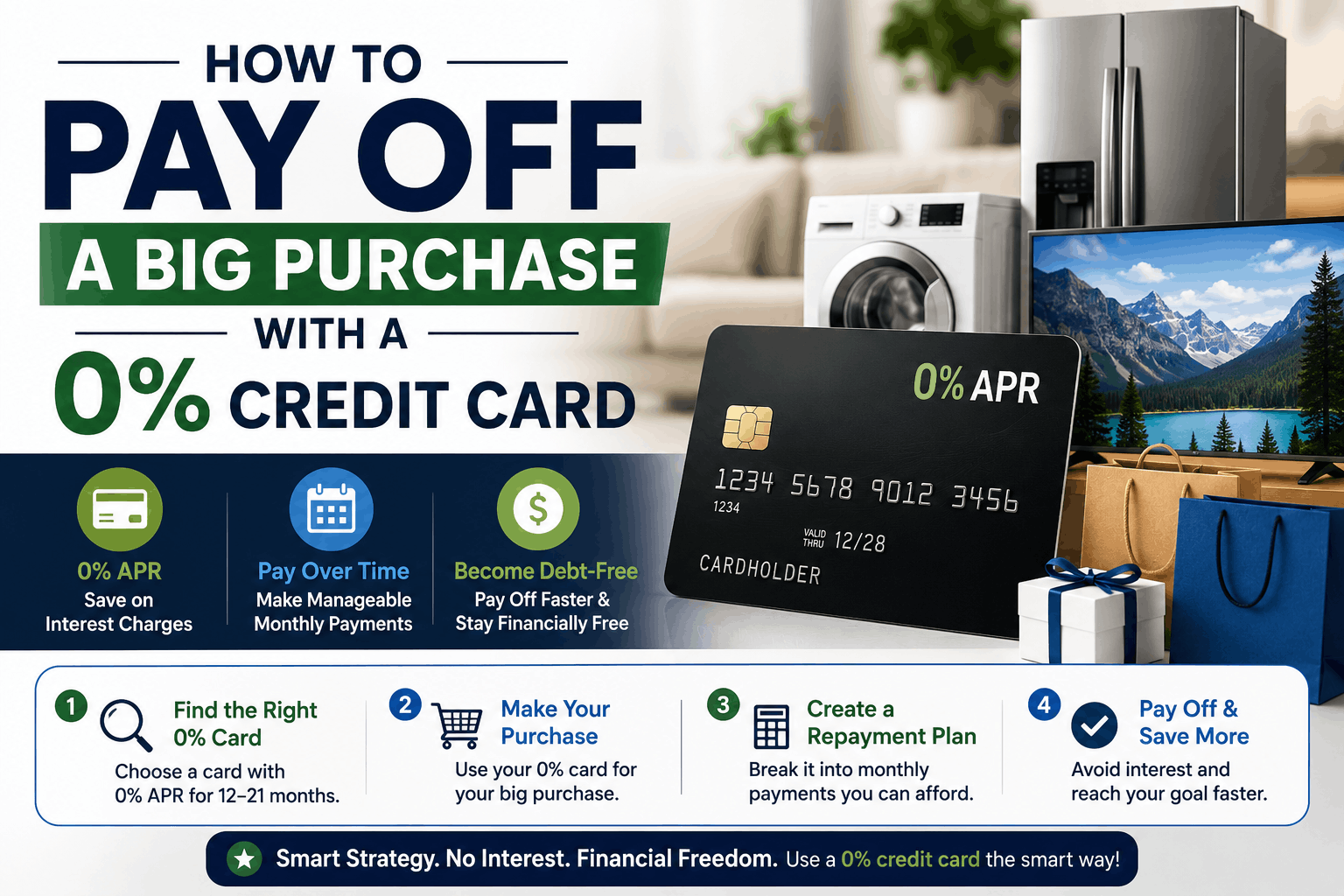
You just made a big purchase — or you’re about to. Maybe it’s a new refrigerator, a laptop, dental work, car repairs, or a few thousand dollars in furniture. The amount is real, and paying it all at once isn’t realistic right now.
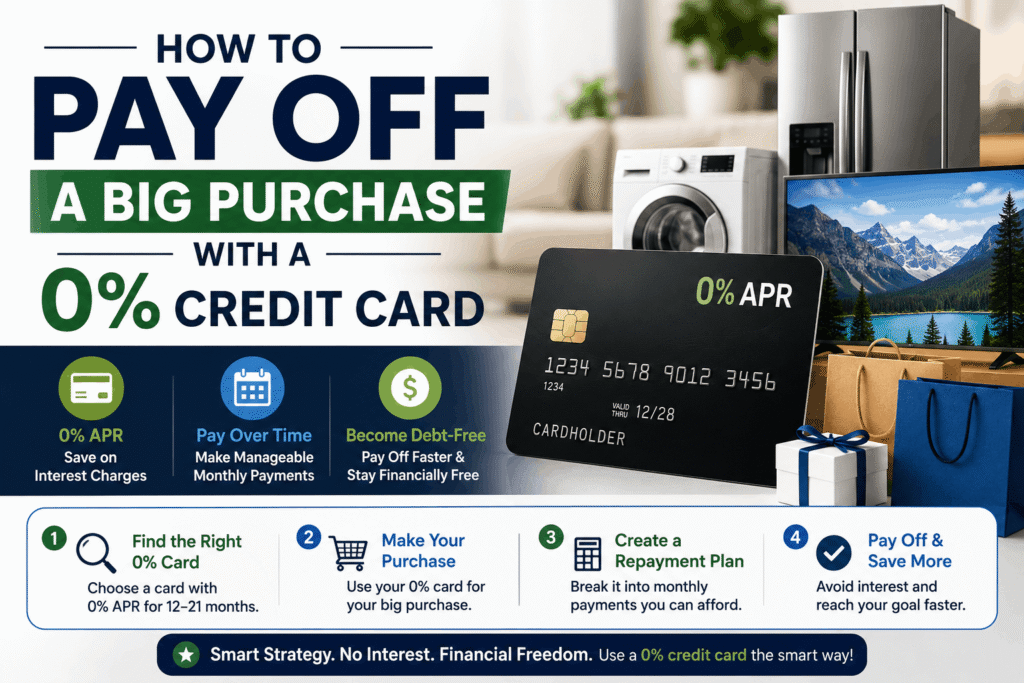
A 0% APR credit card is one of the most straightforward tools for handling this kind of expense without paying interest. Charge the purchase, spread payments across 12 to 21 months, pay zero in interest if you follow the plan. That’s the idea — and when it works, it works well.
But the execution matters more than most people expect. A lot of cardholders get the card, make the purchase, and then slowly drift back into minimum payments — which is exactly how a 0% offer turns into an expensive mistake. This guide walks through the full process, from choosing the right card to making sure the balance actually hits zero before the promo ends.
Table of Contents
Quick Answer: The Basic Payoff Method
Divide your purchase amount by the number of months in your 0% intro period. Pay that amount every single month without exception. Reach month 12 (or 15 or 18, depending on your card) with a zero balance. That’s the whole strategy.
The math is simple. The discipline is where most people struggle.
0% Payoff Strategy at a Glance
| Purchase Amount | Promo Length | Monthly Payment Needed |
|---|---|---|
| $1,200 | 12 months | $100/month |
| $1,800 | 12 months | $150/month |
| $2,400 | 15 months | $160/month |
| $3,000 | 18 months | $167/month |
| $3,600 | 21 months | ~$172/month |
These are interest-free scenarios. If you pay less than the required monthly amount, the remaining balance will face standard APR — often 24%–29% — once the promo ends.
How 0% APR on Purchases Actually Works
When a credit card offers 0% APR on purchases for an introductory period, the issuer suspends interest charges for that window. Your balance only grows from what you spend — no compounding, no interest stacking on top. If you started with $2,000 and paid $1,400 over 12 months, you owe $600 when the promo ends. Not $600 plus 12 months of accrued interest.
That’s genuinely different from how most credit card balances work, and it’s why this tool is useful for planned large purchases.
Two things to clarify immediately.
True 0% APR means interest is completely waived during the promo. If you haven’t paid the full balance by the deadline, only the remaining balance starts accruing interest at the standard rate going forward.
Deferred interest — common on store-branded financing offers — means interest is silently accumulating in the background the entire time. Pay off the balance completely before the deadline and you owe nothing extra. Leave even $1 unpaid and the issuer charges you all the interest that built up from day one. This is a meaningful trap that catches a lot of people.
Major bank cards (Chase, Citi, Discover, Wells Fargo, Capital One) almost always use true 0% APR. Retail store cards and buy-here-pay-here type financing frequently use deferred interest. Always confirm before you charge anything.
Step-by-Step: How to Pay Off a Big Purchase With a 0% Card
Step 1 — Know the Exact Purchase Amount Before Applying
Don’t apply for a card and figure out the spending later. Know exactly what you’re buying and what it costs. This lets you calculate your required monthly payment before you ever open the account.
If the purchase is $1,500 and you’re targeting a 12-month card, you need $125/month. Is that realistic in your current budget? If not, look for a card with a 15 or 18-month window. The right card depends on the math, not just the headline offer.
Step 2 — Choose the Right Card for Your Situation
Not all 0% cards are created equal. Key factors:
- Promo length — Longer is better for larger purchases
- True 0% vs. deferred interest — Confirmed in writing, not assumed
- Annual fee — Avoid annual fees on cards used purely for a payoff strategy
- Credit requirement — Most competitive cards need 670+ FICO
Step 3 — Apply and Confirm the Terms
When you’re approved, read the welcome materials carefully. Confirm:
- Exact promo end date (not just “12 months” — note the actual calendar date)
- Whether purchases and balance transfers have different promo periods
- What triggers promo termination (missed payments, for example)
Your promo period starts from account opening, not your first purchase. If the card takes two weeks to arrive and you wait another three weeks to use it, you’ve already burned more than a month.
Step 4 — Make the Purchase Immediately
Once the card is in hand, make your large purchase right away. Every day you wait shortens the interest-free window. Don’t let the card sit unused in a drawer.
Step 5 — Calculate Your Monthly Payment and Set It Up
Divide the balance by the number of months remaining in your promo period. Set up autopay for that exact amount — not the minimum, not a round estimate. The exact number.
Most issuers let you customize autopay amounts. Use that feature. If you can only set autopay for the minimum, set a recurring calendar reminder to manually pay the correct amount each month.
Step 6 — Don’t Add New Purchases to the Card
This is where the plan quietly unravels for a lot of people. Using the same card for everyday spending complicates the payoff. Every new charge means the balance you divided by 12 is no longer accurate. Keep this card for the single large purchase only. Use a different card for day-to-day expenses.
Step 7 — Track the Balance Monthly
Log in once a month, confirm the balance is declining as expected, and check the promo end date. This takes five minutes. People who skip this step are the ones who arrive at month 13 surprised that interest is now accruing.
Step 8 — Pay Off the Remaining Balance One Month Early
Don’t aim to hit zero exactly at the deadline. Aim to pay off the balance one month before the promo ends. This protects you from billing cycle timing issues, late posting dates, and any last-minute surprises. Finishing early costs you nothing. Finishing late can cost you hundreds.
Best Cards to Use for This Strategy
Wells Fargo Reflect® Card
Best for: The largest purchases needing the longest payoff window
Up to 21 months of 0% APR on purchases and qualifying balance transfers with no annual fee. No rewards, but the extended timeline is genuinely useful for higher balances.
Watch out for: Long intro periods can make people complacent. Set monthly autopay from day one.
Citi Simplicity® Card
Best for: People who want a straightforward card with no late fees
Long 0% intro period, no late fees, no annual fee. The absence of late fees provides a small safety net — but missed payments still affect your credit report.
Limitation: No rewards program. Purpose-built for payoff strategies only.
Chase Freedom Unlimited®
Best for: Earning cash back while paying off a large purchase
If your purchase is in the $1,000–$2,000 range and you’re confident you can pay it off in 12–15 months, this card lets you earn flat-rate cash back on every dollar in the process.
Watch out for: The rewards can make you feel like you’re getting ahead even when the payoff plan has slipped. Cash back doesn’t offset interest.
Discover it® Cash Back
Best for: First-year spenders who want a payoff period plus a sign-up bonus equivalent
15-month 0% intro period plus Discover’s first-year cash back match. If you’re making a large purchase in the first year anyway, the match on whatever cash back you earn is a real bonus.
Limitation: Rotating 5% categories require manual quarterly activation.
Blue Cash Everyday® Card from American Express
Best for: Home purchases — appliances, furniture, grocery spending tied to a home project
Higher cash back at U.S. supermarkets and U.S. online retailers combined with a 0% intro period. If your large purchase overlaps with grocery spending (catering, supplies, home goods delivered online), the rewards stack usefully.
Limitation: Amex acceptance isn’t universal at all smaller retailers.
Real-World Payoff Examples
Example 1 — Furniture purchase, 12-month plan: $1,800 in furniture. Card: Chase Freedom Unlimited, 15-month promo. Monthly payment needed: $120. Monthly cash back earned at 1.5%: roughly $2.70/month on the purchase. Balance reaches zero at month 15. Total interest: $0. Effective cost: $1,800.
Example 2 — HVAC repair, 18-month plan: $3,200 emergency HVAC replacement. Card: Wells Fargo Reflect, 21-month promo. Monthly payment: ~$153. Balance clears with three months to spare. Total interest: $0.
Example 3 — Same HVAC repair, minimum payments only: Same $3,200. Minimum payments average $64/month. After 21 months, roughly $1,900 remains. Standard APR of 26.99% kicks in. At that rate, monthly interest alone runs about $43. The original repair now costs several hundred dollars more by the time it’s fully paid off.
The difference between Example 2 and Example 3 is the payoff plan. Same card, same rate, same purchase.
Hidden Traps That Disrupt the Plan
The Standard APR After the Promo
The rate you’ll face after the intro period ends is significant — typically 19% to 29% depending on the issuer and your credit profile. This isn’t obscure fine print; it’s on the front page of the card terms. Know the number before you apply so it feels real, not abstract.
Promo Rate Loss From Missed Payments
Most issuers can revoke your 0% promotional rate if you miss a payment. One missed due date and you may find the standard APR applied retroactively to your balance. This is disclosed in the terms and it’s not negotiable.
Set autopay for at least the minimum as a backstop — even if you plan to pay more manually each month.
Cash Advance Exclusion
Using your card at an ATM or for cash-equivalent transactions doesn’t qualify for 0% APR. Interest starts immediately, usually at a higher rate than purchases, plus an upfront fee. Don’t use this card for anything except the planned purchase.
New Purchases Complicating the Balance
Say you bought $2,000 of appliances and set up $167/month to clear in 12 months. Then you add a $300 purchase in month three. Your new balance is $2,200 (roughly). Your original payment plan no longer works. Recalculate whenever the balance changes from new spending.
The Promo End Date Isn’t the Statement Date
Your promo period ends on a specific date. Your billing cycle may close several days before or after. To be safe, have the full balance paid at least 5–7 business days before the stated promo end date, not the statement closing date.
Common Mistakes That Derail the Payoff
Applying for the card without budgeting the monthly payment first. The card comes in the mail, the purchase gets made, and only afterward does the monthly math reveal the payment is actually uncomfortably high. Work the math before applying.
Using the same card for everyday purchases. This is probably the single most common mistake. Everyday spending muddles the clean payoff math and makes it harder to track progress.
Waiting too long to use the card after approval. Every week the card sits unused is a week of your promo window gone. Apply, receive, purchase — in sequence, quickly.
Assuming the minimum payment is progress. On a $2,400 balance, the minimum might be $48. That pays mostly fees and a small slice of principal. Twelve months of minimums will not clear a $2,400 balance. It won’t come close.
Not recalculating after partial payments or additional charges. The math needs to be live, not a one-time calculation done at the beginning.
Who Should Probably Skip This Strategy
People with a pattern of carrying balances past promo periods. If this has happened before — and plenty of people know it has — the issue isn’t the card, it’s the plan. A 0% offer applied to an unpayable amount still ends in debt. Be honest about the pattern before applying again.
Anyone with genuinely unstable income right now. A monthly payoff commitment over 12–18 months assumes relatively stable cash flow. If that’s uncertain, a smaller purchase, a saved fund, or a personal loan with fixed payments might be more appropriate.
People applying purely because they got a marketing offer. Applying for a card to fund a purchase you hadn’t planned on making is different from using a card to handle a necessary or intentional expense. The promo offer doesn’t change whether the purchase is affordable.
Those with credit scores below 670. The best 0% purchase APR cards typically require good to excellent credit. Applying without meeting the threshold creates a hard inquiry without the card. Check your score through Experian, Equifax, or TransUnion before applying.
How to Pick the Right Card for Your Payoff Goal
Run through these before applying:
What’s the total purchase amount? Divide it by 12. If that monthly number is comfortable in your budget, a 12-month card works. If it’s tight, look for 15 or 18 months. If it’s clearly unworkable at any promo length, reconsider the purchase amount.
Do you want rewards or just the 0% window? Rewards cards with 0% promos make sense if you’re confident in the payoff plan. If you want the simplest possible tool focused purely on paying off the balance, a no-rewards card like Citi Simplicity or Wells Fargo Reflect is easier to manage.
Is the offer from a bank or a store? Bank-issued cards: true 0% APR almost certainly. Store cards: confirm whether it’s deferred interest. Ask the store’s finance desk to show you the cardholder agreement language — specifically whether unpaid balances at promo end result in retroactive interest charges.
What’s your credit score right now? Good to excellent (670+) for the mainstream options. Check before applying to avoid wasted hard inquiries.
Frequently Asked Questions
Can I transfer a big purchase to a 0% card after I’ve already made it?
Yes, through a balance transfer — but it’s slightly different. Balance transfers typically carry a 3%–5% fee, and the 0% intro period for balance transfers may differ from the purchase APR promo. Some cards offer 0% on both; others only on one. Check the specific offer terms.
What if I can’t pay off the full balance in time?
With true 0% APR cards, the remaining balance starts accruing interest at the standard APR. It’s not ideal, but it’s manageable if you continue paying aggressively. With deferred interest cards, you may owe accumulated interest from the original purchase date — a much worse outcome.
Should I close the card after paying off the balance?
Generally no. Closing a card reduces your total available credit, which raises your credit utilization ratio and can lower your score. Unless there’s an annual fee you want to avoid, keeping the account open with a $0 balance is typically the better move.
Does the 0% APR apply to the full purchase or just part of it?
The intro APR applies to whatever purchases you make during the promo period, up to your credit limit. The full purchase qualifies as long as it doesn’t exceed your available credit.
Can I make extra payments to pay it off faster?
Yes, and there’s no penalty for paying ahead of schedule. Paying more than the calculated monthly amount shortens your timeline and gives you more buffer before the promo ends.
Do I need to notify the issuer that I’m using the card for a specific large purchase?
No. The 0% APR applies automatically during the promo window. No special enrollment required beyond activating the card.
Final Thoughts
Paying off a large purchase with a 0% credit card is one of the more practical tools in personal finance — not because it’s complicated, but because it’s so straightforward when used correctly. The interest-free window buys you time without costing you money.
The only real requirement is a realistic, specific monthly payment plan that you actually follow. Not an intention. An autopay setting and a calendar reminder.
Where people go wrong isn’t usually the card choice. It’s treating the 0% offer as permission to delay thinking about repayment rather than as a structured window to complete it. The promo period has a hard end date. Build your plan around that date — not around what you hope to do eventually.
Done with discipline, this approach genuinely works. Done carelessly, it just defers the same financial stress to a later month with interest on top.
Related reading: Best 0% APR credit cards right now | How to do a balance transfer correctly | What credit score do you need for a no-interest card