
Last Updated: May 2026 | Estimated Read Time: 12 minutes
The Bill That Kept Growing (Sound Familiar?)
A few years back, I had a friend — smart guy, good job, responsible with money in most ways — who put $8,400 worth of home renovation costs on a credit card with a 24% APR. He figured he’d pay it off in a year. Eighteen months later, he’d paid over $1,600 just in interest. Not principal. Interest. He was furious at himself, mostly because he knew better.
That’s the trap most of us fall into. You put something on a credit card with good intentions, life happens, and suddenly you’re paying hundreds of dollars just to keep your balance from growing. It doesn’t feel like debt at first. Then one day it does.
If that story sounds even vaguely familiar — whether it’s medical bills, a kitchen remodel, an HVAC that died in July, or a lingering balance from a rough patch last year — then you’ve probably already heard about 0% intro APR cards. And if you’ve been doing any research, the Wells Fargo Reflect® Card has almost certainly popped up. Multiple times.
So let’s actually break it down. Not the marketing version. The real version — what it does well, where it falls short, who it’s genuinely good for, and who should probably look elsewhere.
Table of Contents
What Exactly Is a “No Interest” Credit Card?
Let’s be clear about the terminology first, because “no interest credit card” is a bit misleading if you take it literally.
What these cards actually offer is a 0% intro APR — an introductory period during which no interest accrues on your balance. After that period ends, the regular APR kicks in. So it’s not permanently interest-free. It’s a window. A really useful window, if you use it right.
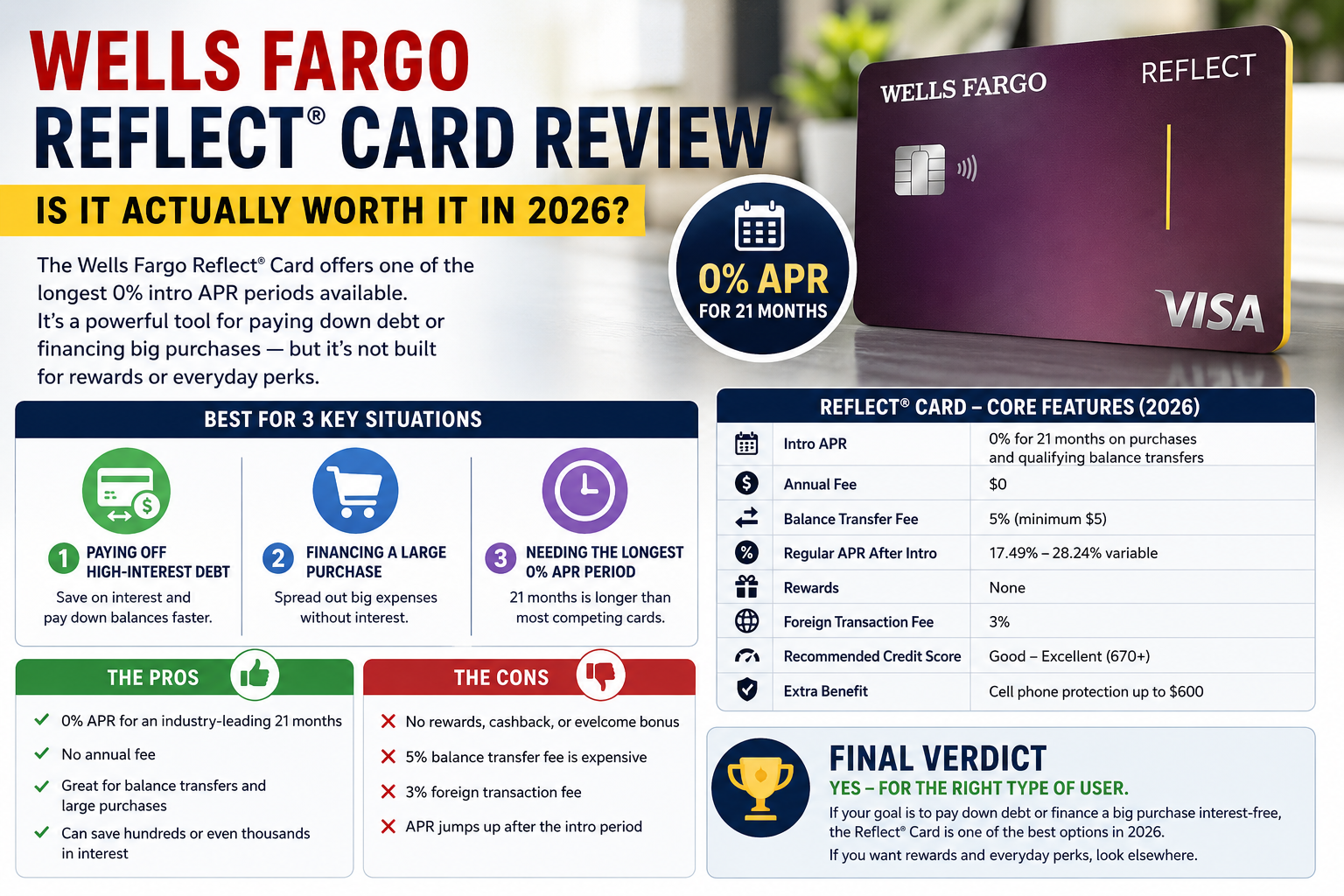
The Wells Fargo Reflect® Card offers one of the longest such windows currently available: 0% intro APR for 21 months from account opening on both purchases and qualifying balance transfers.
That’s close to two full years. Put that in perspective — 21 months is enough time to pay off a $10,000 balance at roughly $476/month with zero interest. On a typical 22% APR card, that same payoff would cost you well over $2,000 in interest charges on top of the principal.
This card isn’t magic. But that math is pretty hard to ignore.
How Does It Actually Work?
Here’s where people get confused, and honestly, the credit card industry doesn’t try very hard to un-confuse you. So let me walk through it clearly.
Purchases
When you use the Reflect Card for new purchases, you pay 0% interest on those purchases for 21 months from the day your account opens. Say you need a new HVAC system in June and it costs $6,000. You charge it to the card, make regular monthly payments throughout the promo period, and as long as you pay it off before month 22, you owe zero in interest. None.
Balance Transfers
This is where most people come for the Reflect Card. If you’ve got existing debt on a high-interest card — maybe a Chase card at 26%, a store card at 29%, whatever — you can transfer that balance to the Reflect Card and it falls under the same 0% intro APR umbrella.
Balance transfers must be made within 120 days of account opening to qualify for the introductory rate. Miss that window, and you’re looking at the regular APR instead.
What Happens After 21 Months?
This is the part the brochure buries in the fine print. After the intro period, the regular APR is 17.49%, 23.99%, or 28.24% Variable — depending on your credit profile when you applied. If you have excellent credit, you might land in the lower tier. If your score is more “good” than “great,” you might end up at the higher end.
Any remaining balance when the promo period ends? It starts accruing interest immediately at that rate. This is why having a payoff plan isn’t optional — it’s the whole point.
The Rules You Cannot Afford to Ignore
I’ve seen people blow this offer in ways that were completely avoidable. Here’s what you absolutely need to know:
Make Every Minimum Payment On Time
This one’s non-negotiable. If you miss a payment or pay late, Wells Fargo can revoke the 0% intro APR. Immediately. Your entire remaining balance could suddenly be subject to the regular APR. I’ve talked to people who lost their promo rate over a $25 minimum payment they forgot. Don’t be that person. Set up autopay for at least the minimum the day you open the account.
Understand What “Minimum Payment” Means
Making the minimum payment keeps the promo rate intact, but it won’t get you out of debt. Minimum payments are designed to keep you in debt for as long as possible — that’s not conspiratorial, it’s just math. If your goal is to actually pay off the balance, you need to calculate what monthly payment gets you to zero by month 21, then make that payment every month.
Don’t Use This Card for Everyday Rewards Spending
The Reflect Card earns no rewards. Zero. It’s not designed for that. Using it to accumulate grocery points or travel miles is like using a hammer to stir soup. Wrong tool. Keep it separate and use it only for the debt or purchase you’re intentionally financing.
New Card Eligibility Rules
You’re not eligible for intro APR offers on a Wells Fargo-branded card if you’ve already received a bonus or intro APR offer on another Wells Fargo card within the past 48 months. So if you opened the Active Cash Card two years ago and used that intro offer, you may not qualify for the Reflect’s intro rate. Check this before applying.
Balance Transfer Fees, Hidden Costs & Real Math
Let’s talk about the fee that a lot of reviews gloss over.
The balance transfer fee on the Reflect Card is 5% of the transfer amount, with a minimum of $5.
That’s not nothing. On a $5,000 transfer, you’re paying $250 upfront. On $10,000, that’s $500.
But here’s how you should actually think about it: compare it to what you’d pay in interest without the transfer.
Real example — let’s say you have $7,500 on a card at 24% APR and you’re paying $300/month:
- Without the Reflect Card: You pay roughly $2,100+ in interest over ~33 months before that balance hits zero.
- With the Reflect Card (balance transfer): You pay a $375 fee upfront, then $357/month for 21 months to pay it off completely. Total extra cost: $375. Zero interest.
The math is pretty straightforward once you run it. For most balances at high APRs, the 5% fee pays for itself in the first few months of avoided interest.
If you make a $10,000 purchase and pay it off in $500/month increments, the Reflect Card costs you $0 in interest. A standard card at 20% APR on the same plan would cost you roughly $2,291 in interest — and take several months longer to pay off.
The only scenario where the transfer fee doesn’t make sense? If your existing card’s APR is already low, or if your balance is small enough that you can pay it off quickly anyway. In those cases, a transfer might cost more than it saves.
The Honest Pros and Cons
Let me be straight with you here instead of just cheerleading.
The Good Stuff
One of the longest 0% intro windows available. The Wells Fargo Reflect Card won the “Best 0% Intro APR Credit Card” award for 2026 from multiple personal finance publications — and that’s genuinely because 21 months on both purchases and balance transfers is rare. Most competitors split the deal: longer on balance transfers, shorter on purchases. Reflect gives you the full window on both.
No annual fee. You’re not paying $95 or $195 to access this benefit. That matters, especially if you’re already trying to get out of debt.
Cell phone protection. Honestly kind of a sleeper perk. Wells Fargo offers up to $600 coverage against phone damage or theft when you pay your monthly bill with the card, subject to a $25 deductible. Not why you’d get the card, but nice to have.
120-day balance transfer window. Unlike some competitors that require balance transfers within 4 months, Wells Fargo gives you up to 120 days — that’s 4 full months — for transfers to qualify for the intro APR. That’s a more comfortable timeline.
Pre-qualification tool. Wells Fargo has a pre-selection tool that doesn’t require a hard credit pull, so you can check your odds without dinging your score. Use this before you officially apply.
The Not-So-Good Stuff
No rewards. At all. The Reflect Card earns exactly nothing on purchases. If you’re using it for a large new purchase and plan to keep the card afterward, you’ll want a different card for day-to-day spending. The Reflect is a focused tool, not a long-term everyday card.
5% balance transfer fee is on the higher end. Some competitors charge 3% (especially with intro transfer fee periods). The Citi Diamond Preferred, for example, currently offers 3% for transfers made in the first 4 months. On large balances, that difference adds up.
3% foreign transaction fee. Don’t take this card abroad. Seriously. Any international purchase will cost you an extra 3%. Leave it at home.
Post-promo APR can be high. If you’re in the 28.24% tier after the promo ends, that’s worse than most standard cards. Which means the stakes of not paying it off on time are higher, not lower.
No welcome bonus. No cash back, no points, no statement credits. Just the interest savings. For some people, that’s a fine tradeoff. For others, it feels like leaving money on the table.
Who Should Get This Card — And Who Shouldn’t
You’re a good fit if…
- You have high-interest credit card debt ($3,000+) and a realistic plan to pay it off within 21 months
- You’re planning a large purchase — home renovation, medical procedure, appliances, a necessary car repair — that you want to spread over 18-21 months without interest
- You have good to excellent credit (670+ FICO) and can likely qualify
- You’re disciplined enough to set up automatic payments and stick to a monthly payoff schedule
- You don’t need a rewards card and you’re okay having a separate card for everyday spending
You should probably look elsewhere if…
- You can realistically pay off your balance in 6 months or less — a shorter 0% offer with a lower transfer fee might serve you better
- You want rewards and can pay your balance in full monthly — the Active Cash Card or Autograph Card would give you more long-term value
- Your credit score is below 670 — approval odds drop significantly, and you might not qualify for the full 21-month offer anyway
- You tend to miss payments or have inconsistent cash flow — losing the promo rate would be worse than just staying on your current card
- You’re thinking about using this for ongoing everyday spending — wrong card for that
Smart Strategies to Actually Make This Work
If you’ve decided this card makes sense for your situation, here’s how to squeeze every last dollar of value from it.
Do the math before you apply. Divide your total balance (plus the 5% transfer fee if applicable) by 21. That’s the monthly payment you need to hit zero before the promo ends. Is that payment realistic for your budget? If yes, proceed. If not, reconsider.
Set up autopay the day your card arrives. Not next week. Not after you finish your coffee. The day it arrives. Set it for the full calculated monthly amount, or at minimum, the minimum payment as a backup. The promo rate is worth protecting.
Don’t add new charges you can’t immediately pay off. Every new purchase you make on this card competes with the balance you’re trying to eliminate. If you transfer $8,000 and then start adding groceries and gas, your payoff math gets blurry fast.
Keep a simple spreadsheet. Literally just: month, balance, payment, new balance. Takes 5 minutes a month and keeps you honest. Some people can track this mentally. Most can’t, and those people are the ones who hit month 20 with $4,000 still sitting there.
Transfer your highest-rate debt first. If you have balances on multiple cards, prioritize moving the one with the highest APR. That’s where interest is eating you alive the fastest.
Check your credit utilization before applying. Opening a new card affects your credit temporarily, but if you’re transferring a large balance, your new card’s utilization will be high. That can temporarily dip your score. It’s not permanent, but be aware if you’re planning other credit applications in the near future.
Wells Fargo’s Current 0% APR Cards in 2026 (Quick Comparison)
Wells Fargo actually has a couple of cards worth knowing about:
Wells Fargo Reflect® Card
- 0% intro APR for 21 months on purchases and qualifying balance transfers, then 17.49%, 23.99%, or 28.24% Variable APR
- No annual fee, no rewards
- Best for: Debt payoff or large purchase financing over a long timeline
Wells Fargo Active Cash® Card
- 0% intro APR for 12 months on purchases and qualifying balance transfers, then 18.49%, 24.49%, or 28.49% Variable APR
- 2% flat cash rewards on all purchases, $200 welcome bonus after $500 spend in 3 months, no annual fee
- 3% intro balance transfer fee for the first 120 days, then up to 5%
- Best for: Someone who wants a shorter 0% window and ongoing rewards after it ends
Wells Fargo Autograph® Card
- 0% intro APR for 12 months on purchases only
- 3X points on restaurants, travel, gas, transit, streaming, and phone plans; 1X on everything else
- 20,000 bonus points after $1,000 spend in first 3 months
- Best for: Everyday rewards spending, not primarily for debt payoff
For pure interest savings over the longest possible window? The Reflect Card wins by a clear margin. For a balance between short-term savings and long-term rewards value, the Active Cash is worth a serious look.
Conclusion: Is the Wells Fargo Reflect Card Worth It?
Here’s my honest take after years of writing about these products: the Wells Fargo Reflect Card is one of the most straightforward, genuinely useful tools in the credit card market right now — for the right person.
It’s not flashy. There are no rewards, no travel perks, no concierge number to call when you want restaurant reservations. It does one thing: give you a very long runway to pay off debt or a large purchase without interest compounding against you every month.
On a $20,000 balance paid at ~$952/month, someone using the Reflect Card saves over $5,600 in interest compared to carrying that balance on a standard card at 22.5% APR. That’s real money. That’s a vacation, three months of groceries, or a meaningful chunk of an emergency fund.
But — and I cannot stress this enough — this card is a tool, not a solution. The discipline has to come from you. If you transfer a balance, watch the clock from day one. Know your payoff number. Pay on time every month. Don’t add unnecessary purchases. And when the 21 months are up, make sure there’s nothing left on that balance.
Used with intention, this card can genuinely save you thousands. Used carelessly, it just delays the same problem and adds a 5% fee on top.
Final verdict: If you have high-interest debt and a realistic plan, the Wells Fargo Reflect Card is hard to beat in 2026. Just go in with eyes open and a spreadsheet ready.
Actionable Takeaways
- Calculate your required monthly payment (balance ÷ 21) before applying
- Use the Wells Fargo pre-qualification tool — no hard pull required
- Set up autopay immediately after card approval
- Transfer balances within the 120-day window to lock in the 0% rate
- Don’t use the card for everyday spending — keep it dedicated to payoff
- Plan for what comes after Month 21 (different card, balance fully paid, or refi)
One last warning: If you open this card, transfer a balance, and then continue accumulating debt on your old cards, you haven’t solved anything — you’ve doubled it. The Reflect Card only works if the card you transferred from stays at zero going forward. That part’s on you.
Frequently Asked Questions
What is the Wells Fargo no interest credit card?
The primary Wells Fargo “no interest” card is the Wells Fargo Reflect® Card, which offers 0% intro APR for 21 months on both purchases and qualifying balance transfers. “No interest” refers to this promotional period — after 21 months, the regular variable APR applies (17.49%, 23.99%, or 28.24% depending on creditworthiness).
How long is the 0% APR period on the Wells Fargo Reflect Card?
21 months from account opening — one of the longest intro APR windows currently available on any no-annual-fee credit card in the U.S. market.
What credit score do I need for the Wells Fargo Reflect Card?
Generally, good to excellent credit is required — a FICO score of 670 or higher gives you a reasonable shot. Higher scores (750+) are more likely to result in approval and a lower ongoing APR tier.
Is there a balance transfer fee on the Wells Fargo Reflect Card?
Yes. The balance transfer fee is 5% of the transfer amount (minimum $5). This applies to transfers made within the 120-day qualifying window. Factor this into your savings calculation before transferring.
Can I use the Wells Fargo Reflect Card for everyday spending?
Technically yes, but it’s not designed for that. The card earns no rewards on any purchases. You’d be better served using a cash back card (like the Active Cash) for day-to-day spending and keeping the Reflect dedicated to your debt payoff or large purchase plan.
What happens if I miss a payment on a 0% APR card?
Missing a payment — or even paying late — can result in Wells Fargo revoking your introductory 0% APR. Your remaining balance would then be subject to the regular APR immediately. Always set up autopay for at least the minimum payment to protect the promo rate.
Does the Wells Fargo Reflect Card earn cash back or rewards?
No. The Reflect Card earns zero rewards. It’s purely a low-cost financing tool. If you want rewards plus a shorter intro APR, the Wells Fargo Active Cash Card (2% cash back, 0% for 12 months) is a better fit.
Is the Wells Fargo no interest credit card good for debt consolidation?
Yes — it’s one of the strongest options available for balance transfers in 2026, specifically because the 21-month window applies to balance transfers as well as new purchases. The 5% fee is a cost to factor in, but for most high-interest balances, the interest savings far outweigh that upfront fee.
Can I transfer a balance from another Wells Fargo card?
No. Wells Fargo does not allow balance transfers between Wells Fargo accounts. You can only transfer balances from cards issued by other banks or lenders.
How does the Wells Fargo Reflect Card compare to the Citi Diamond Preferred?
Both offer 21-month 0% intro APR on balance transfers and no annual fee. The key differences: the Reflect Card offers 21 months on purchases too (Citi offers only 12 months on purchases), while the Citi Diamond Preferred has a lower 3% intro transfer fee (vs. Reflect’s 5%). If you’re primarily transferring a balance and can move quickly, the Citi card’s lower fee may save more. If you need the full 21 months on new purchases too, Reflect wins.
Rates, terms, and offers mentioned in this article are based on publicly available information as of May 2026 and are subject to change. Always verify current terms directly with Wells Fargo before applying. This article is for informational purposes only and does not constitute financial advice.