
Carrying credit card debt at 20%+ APR gets exhausting fast. You watch the balance barely budge every month, and the interest charge feels like a punishment for something you’re still paying off from years ago. Balance transfers exist to give people a break from that cycle — but they come with rules, limits, and traps that most people don’t fully understand before jumping in.
One of the most common questions people have: can I just keep doing balance transfers to avoid interest forever? The short answer is no — but the full picture is more nuanced than that.
Table of Contents
Quick Answer: How Many Balance Transfers Can You Do?
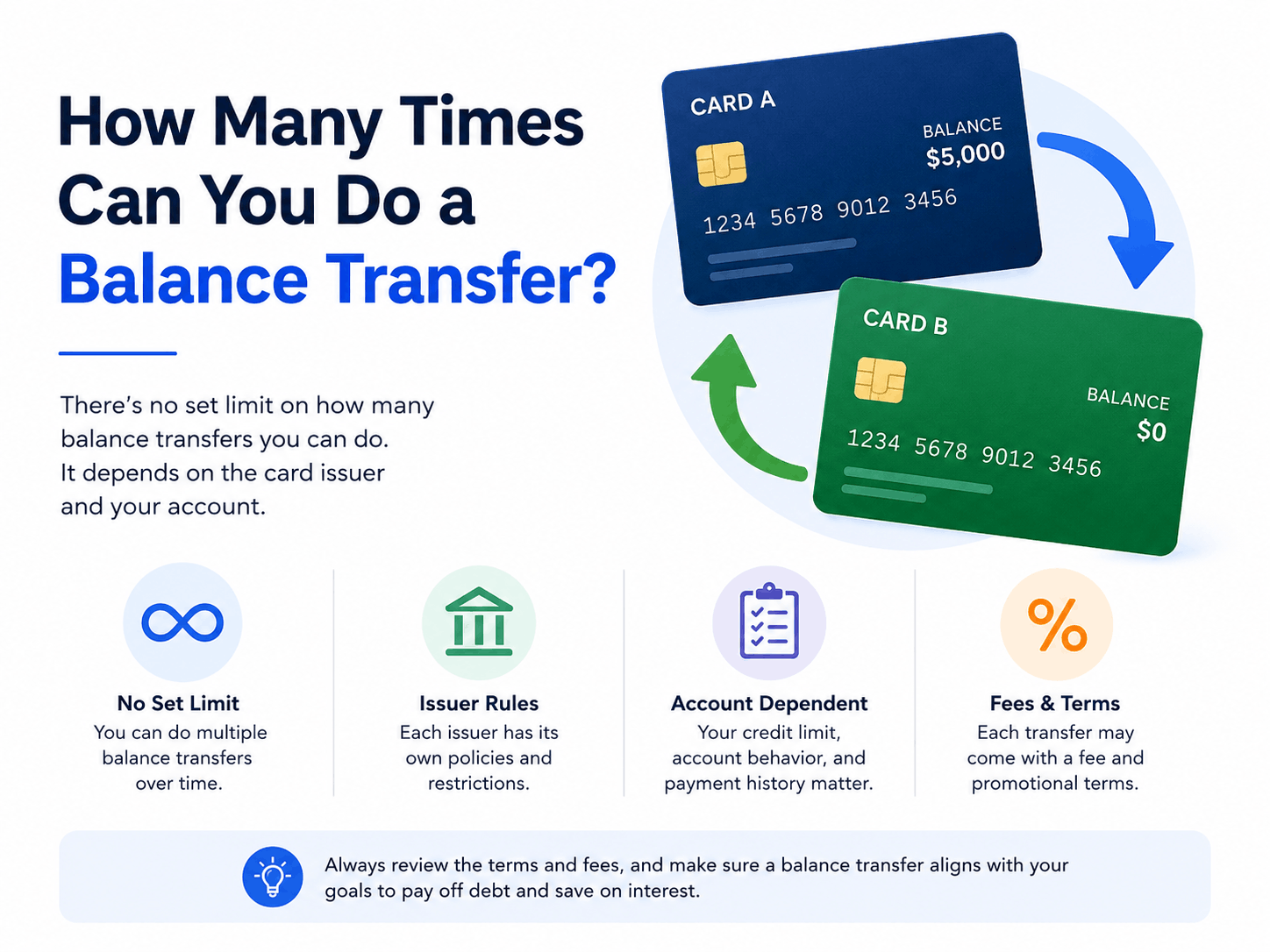
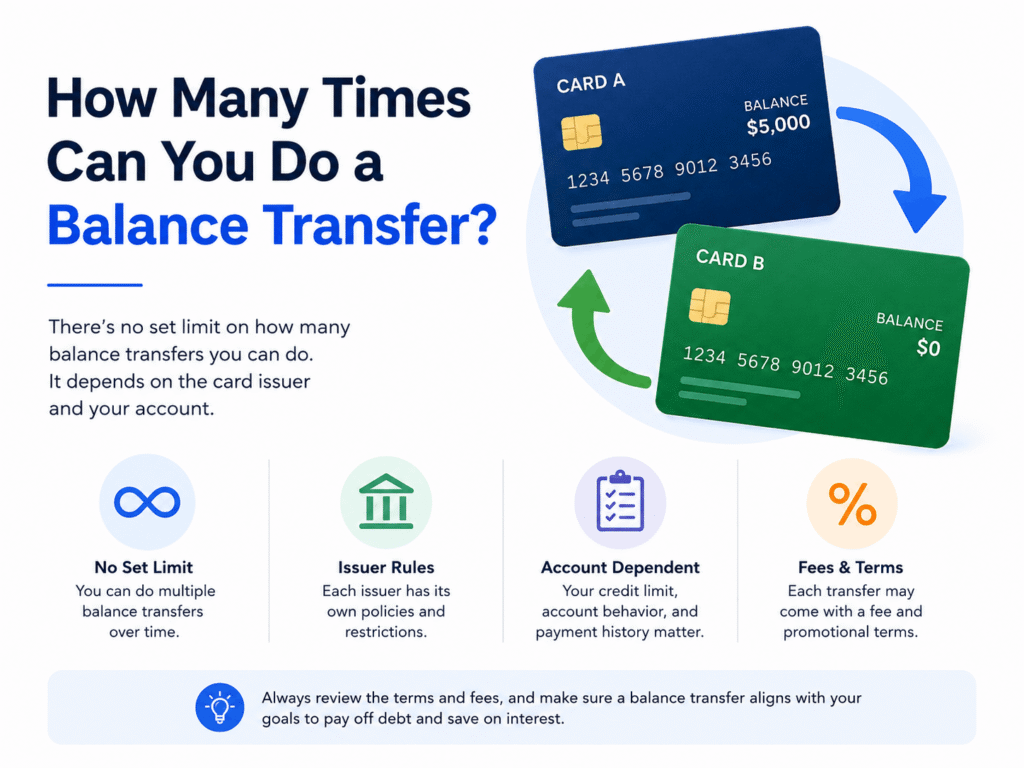
There’s no universal legal limit on how many balance transfers you can do over your lifetime. But in practice, you’re limited by:
- How many balance transfer cards you can qualify for
- Your available credit on each card
- Your credit score after each application
- The card issuer’s own internal rules
Most people can do 2–4 balance transfers over a few years before approval becomes harder or the math stops working in their favor.
| Factor | What It Means Practically |
|---|---|
| No legal cap | You can apply for multiple BT cards |
| Credit score impact | Each application = hard inquiry |
| Available credit | Transfer limited to your credit limit |
| Issuer restrictions | Can’t transfer balances between same bank’s cards |
| Transfer fees | Usually 3%–5% per transfer |
| Promotional APR window | Typically 12–21 months |
What Is a Balance Transfer, Really?
A balance transfer moves debt from one credit card to another — usually to a new card offering 0% APR for an introductory period. Instead of paying 22% interest on your old card, you pay 0% for 12 to 21 months on the new one.
The idea is simple: pay down principal aggressively during that window, then close out the balance before regular APR kicks in.
What people sometimes miss is that this isn’t free money. Most cards charge a transfer fee of 3% to 5% upfront. On a $5,000 balance, that’s $150 to $250 added immediately. Worth it if you’re saving hundreds in interest — not worth it if you’re only transferring a small balance with a short promo period.
Can You Do Multiple Balance Transfers at the Same Time?
Yes, technically. You could apply for two or three balance transfer cards in the same period and move different balances to each one. Some people do this to handle debt from multiple high-interest cards simultaneously.
The problem is that every new card application triggers a hard credit inquiry. Multiple hard inquiries in a short period can drop your credit score meaningfully — sometimes 5 to 15 points per inquiry depending on your credit profile. That lower score then affects whether your next application gets approved, and at what credit limit.
There’s also a practical ceiling: the amount you can transfer is capped at the credit limit you’re approved for. If you owe $8,000 and get approved for a balance transfer card with a $4,000 limit, you can only move half the debt.
How Often Can You Do Balance Transfers Over Time?
This is where the real-world math matters more than the theoretical answer.
Year 1: You transfer $6,000 in debt to a 0% APR card with an 18-month promotional period. You pay it down aggressively.
Year 2: The promo period is ending. You still have $2,000 left. You apply for a new balance transfer card and move the remaining balance. Another transfer fee, another hard inquiry, another clock starting.
Year 3: Credit card issuers are starting to notice the pattern. Your credit score has taken some hits from multiple inquiries and new accounts. Approval isn’t guaranteed. Some issuers may decline you specifically because of frequent balance transfer activity.
Most financial advisors and credit professionals will tell you that doing this more than 2–3 times starts costing more than it saves, both financially and in terms of credit health.
Best Balance Transfer Card Types (And Who They’re For)
Long Promotional Period Cards (18–21 Months)
Best for: People with $3,000–$10,000 in high-interest debt who have a realistic plan to pay it off completely within the window.
Advantages: Maximum time to pay down debt without interest. Lower monthly payment pressure.
Downsides: Usually require good to excellent credit (typically 670+). The regular APR after the promo ends can be 19%–29%.
Hidden risk: If you don’t pay off the balance before the promo ends, you’re back to paying high interest — sometimes on the remaining balance plus whatever you spent on the card during the promo period.
Who should avoid it: Anyone without a realistic monthly payment plan. If you can’t consistently put money toward the balance, you’ll just be delaying the problem.
No-Transfer-Fee Cards
Best for: People transferring smaller balances ($1,000–$3,000) where the 3–5% fee would eat into savings.
Advantages: No upfront cost to transfer.
Downsides: Promotional periods are often shorter (12–15 months). Credit limit approvals tend to be lower.
Important warning: Always confirm whether “no transfer fee” applies only to transfers made within the first 60 days of account opening. Many cards drop this benefit after that window.
Cards With Ongoing Low APR (Not Just Promotional)
Best for: People who won’t pay off the full balance within the intro period and want a lower ongoing rate.
Advantages: Less dangerous if you carry a remaining balance after the promo ends.
Downsides: Ongoing low APR cards are harder to find. The “low” rate is often still 10%–15%, which is better than 25% but not free.
Real-World Cost Example
Let’s say you’re carrying $7,500 on a card with 24% APR, paying $250/month.
Without a balance transfer: You’d pay roughly $3,200+ in interest over the payoff period — and it takes nearly 4 years.
With a balance transfer to a 0% card (18 months, 3% fee): Transfer fee: $225 Monthly payment needed to pay off in 18 months: ~$417 Total interest paid during promo: $0 Total cost: $225
That’s a significant saving — but only if you actually pay it off in time. If you’re still carrying $3,000 when the promo ends and the rate jumps to 26%, you’ve just created a new problem.
Hidden Fees and Traps to Know Before You Transfer
Transfer fee on the new balance: Standard is 3–5%. Some cards advertise no fee, but read the fine print on timing.
Minimum payment trap: Paying only the minimum during the promo period can leave a large remaining balance when the regular APR kicks in. The minimum payment is not a payoff plan.
New purchases APR: Many balance transfer cards charge regular APR on new purchases immediately, even during the 0% promo period. Using the card for everyday spending while trying to pay down a transferred balance creates two separate balances with different rates — and payments often go toward the lower-rate balance first.
Penalty APR: Missing a payment can eliminate your promotional rate entirely on some cards. You’d jump from 0% to 29.99% overnight. This is buried in the cardholder agreement and catches people off guard.
Same-bank restriction: You cannot transfer a balance from a Chase card to another Chase card, or Citi to Citi, and so on. The transfer has to cross institutions.
Common Mistakes People Make With Balance Transfers
Transferring more than they can realistically pay off. Moving $10,000 in debt to a 15-month 0% card sounds great until you realize you need to pay $667/month to clear it. If that’s not realistic, you’re setting yourself up to still have a large balance when the promo ends.
Continuing to use the old card. After a balance transfer, many people feel psychological relief — and start spending on the original card again. Now you have two growing balances.
Not reading the terms on what the promo covers. Some 0% offers apply only to transferred balances, not purchases. Some apply to both. Assuming they’re the same can lead to unexpected interest charges.
Chasing balance transfers without paying down debt. If you’re moving balances every 12–18 months but not actually reducing the principal, you’re just treading water while paying transfer fees each time.
Applying for too many cards at once. Multiple hard inquiries in a short window signal financial stress to lenders. It can lower your score and reduce your chances of approval on the next application.
Who Should Avoid Balance Transfers Altogether?
Balance transfers aren’t for everyone. Be honest with yourself here.
If your credit score is below 650, you’re unlikely to qualify for cards with meaningful 0% promotional periods. You might get approved for something, but the terms won’t be favorable.
If you have a history of minimum payments, a balance transfer gives you a temporary rate advantage but doesn’t fix the underlying behavior. The debt will follow you.
If the balance is small enough to pay off in 3–4 months at your current rate, the transfer fee may actually cost more than just paying it down now.
If you’re planning a major loan application (mortgage, auto, business loan) in the next 6–12 months, new card applications and hard inquiries can complicate that process.
If you don’t have a concrete monthly payment plan, a balance transfer just delays the debt — it doesn’t reduce it on its own.
How to Decide If Another Balance Transfer Makes Sense
Before applying for another balance transfer card, run through these questions honestly:
1. What’s the remaining balance I want to transfer? Calculate it exactly. Include any upcoming interest charges before the transfer clears (which usually takes 7–14 days).
2. What’s the transfer fee? 3% on $4,000 is $120. 5% on $4,000 is $200. Is the interest you’d save larger than that fee?
3. What’s the promotional period? Divide the balance by the number of months. That’s your required monthly payment. Can you actually make that payment?
4. How many hard inquiries do you already have this year? Check your credit report. If you’ve already applied for 2–3 cards or loans, another inquiry could meaningfully hurt your approval odds or credit limit.
5. What happens if you don’t pay it off in time? Look up the regular APR on the new card. If it’s 27%, you need to be prepared for that possibility — not just hope you’ll be fine.
Frequently Asked Questions
Does doing a balance transfer hurt your credit score? It can, slightly and temporarily. Applying for a new card triggers a hard inquiry (typically minus 2–10 points). Opening a new account also lowers your average account age, which affects your score. On the positive side, transferring a balance increases your total available credit, which can improve your credit utilization ratio — often a net positive if the card has a decent limit.
Can I transfer a balance to a card I already have? Only if that existing card is offering a promotional balance transfer rate. Some issuers do send existing cardholders promotional BT offers. You can’t transfer to a card that doesn’t have an offer active — and never to a card from the same bank as the original debt.
How long does a balance transfer take to process? Usually 7 to 14 business days. During that time, keep making minimum payments on your old card to avoid late fees or damage to your credit. Don’t assume the transfer has cleared until you verify it.
What happens if I go over the credit limit during a transfer? The transfer may be partially approved (up to your limit) or declined. Some issuers will transfer what they can and reject the rest. You’ll typically receive a notice explaining what happened.
Can I do a balance transfer if I have bad credit? It’s difficult. Most 0% APR balance transfer cards require good credit (670+). Some secured cards or credit union options may offer balance transfers for lower credit scores, but the terms are rarely favorable enough to make financial sense.
Is there a limit on how many balance transfer cards I can have at once? No hard legal limit, but each application requires approval. Each issuer sets its own policies. Having many recent card applications on your credit report makes future approvals harder regardless of the policy specifics.
Final Thoughts
Balance transfers work when used deliberately — not as a long-term debt management strategy, but as a one-time (or occasionally two-time) tool to buy yourself breathing room and aggressively pay down a balance without interest eating into every payment.
The people who benefit most are the ones who do the math in advance, commit to a monthly payment that will realistically clear the balance before the promo ends, and don’t use the old card again while the transfer is active.
The people who struggle are the ones who keep repeating the cycle — moving debt from card to card, paying transfer fees each time, never actually reducing principal — until their credit score catches up with them and the approvals stop coming.
You can technically do a balance transfer many times. Whether you should is a different question entirely.